For coaches and consultants, trust is the product. Before a potential client books a discovery call, they've already decided whether they believe you can solve their problem. Podcasting builds that trust at scale — episode by episode, week by week — reaching prospective clients during their commutes and workouts in a way that a LinkedIn post or email newsletter simply can't replicate. The problem has never been the strategy. It's been the production. AI has solved that.
Why Coaches and Consultants Use Podcasting
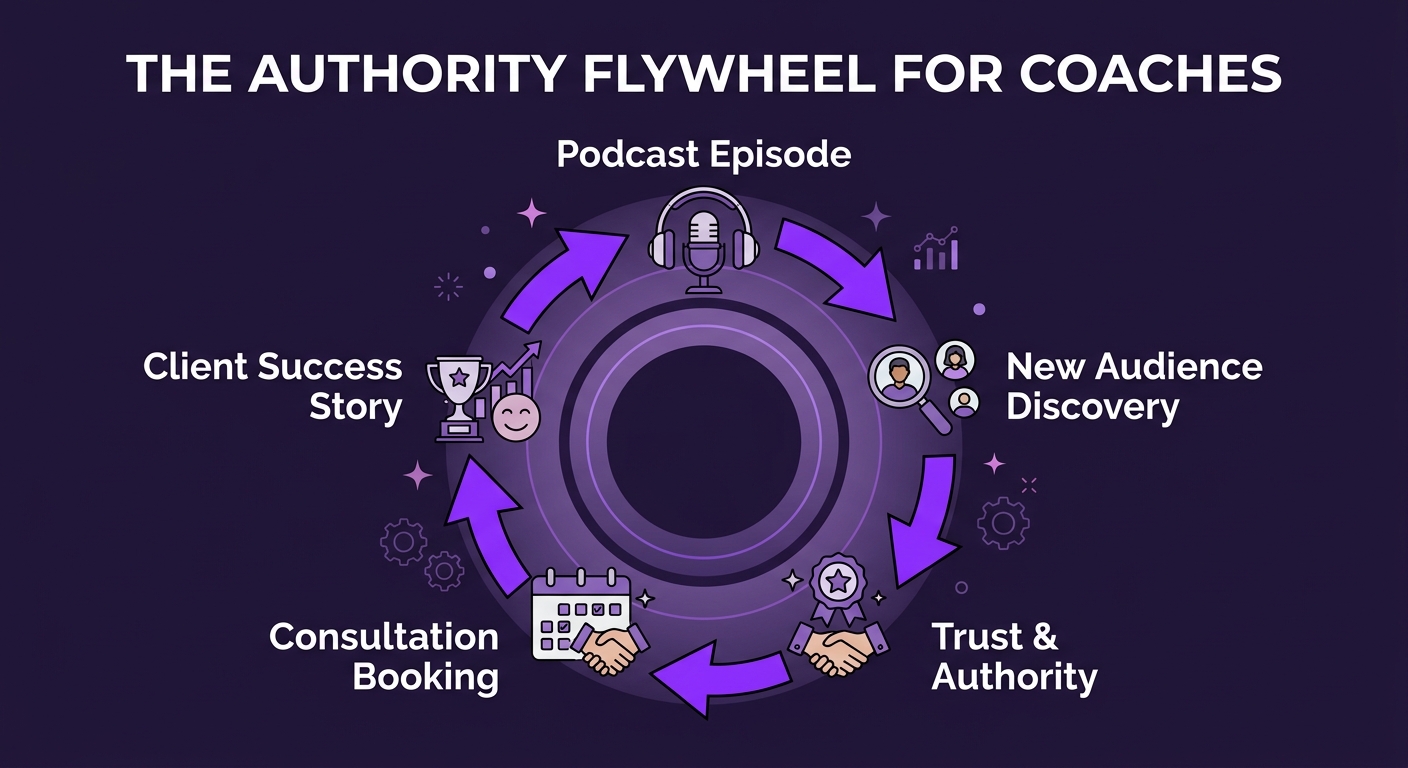
The traditional model for coach and consultant marketing is heavily referral-dependent. Referrals are great — conversion rates are high, trust is pre-established — but they're not scalable and they're unpredictable. Podcasting creates an inbound lead channel that compounds over time:
- Thought leadership at scale: Every episode positions you as an expert in your niche to an audience that self-selected to listen to you. There's no equivalent to this level of self-qualified attention in paid advertising.
- Shortened sales cycle: A prospect who has listened to 10 of your episodes arrives at a discovery call already convinced of your expertise. Many coaches report that podcast-sourced leads require significantly fewer touch points before converting to paying clients.
- Passive content working 24/7: Unlike a live webinar or a social post that fades from feeds within hours, podcast episodes continue being discovered and consumed for months or years. Your back-catalog is perpetually working for you, even when you're with clients or sleeping.
- Niche positioning: A podcast that consistently addresses the specific problems of a narrow niche audience builds category authority faster than broad-audience content. Being "the podcast for female founders navigating their first exit" is a clearer market position than "business coach."
The Numbers Behind Coach Podcasting
| Metric | Figure | Source |
|---|---|---|
| Podcast listeners who act on a recommendation from a host they trust | 63% | Spotify Advertising Research, 2024 |
| Average income increase for coaches who publish consistently for 12+ months | 31% | International Coaching Federation, 2024 |
| Podcast listeners who are more likely to engage with a brand vs. non-listeners | 5.4x | Nielsen Audio Brand Impact, 2024 |
| B2B buyers who consume 3+ pieces of content before a purchase decision | 74% | Demand Gen Report, 2025 |
| Coaches who cite content marketing as their top inbound lead source | 44% | ICF Global Coaching Study, 2025 |
| Reduction in required sales touchpoints for podcast-nurtured leads | 35–50% | HubSpot Research, 2025 |
"Our podcast became our single highest-converting marketing channel within 8 months. Every guest or client I work with now comes in having already listened to 5–15 episodes. The discovery call is a formality — they've already decided they want to work with me before they even reach out."
— Executive Coach, cited in Forbes Coaches Council, 2025
Why Traditional Podcasting Fails Solo Practitioners
Coaches and consultants are time-constrained by definition — their time is the product they sell. Every hour spent on production is an hour not spent with clients, which means traditional podcast production creates a real economic conflict. The typical production workflow for a solo practitioner without a team:
- Write or outline the episode (1–2 hours)
- Set up recording environment and equipment (20–30 minutes)
- Record the episode, usually requiring multiple takes (45–90 minutes)
- Edit out mistakes, dead air, and filler words (1–3 hours)
- Add intro/outro music and level audio (30–60 minutes)
- Write show notes and upload to host (30–45 minutes)
- Share to social platforms (15–30 minutes)
Total: 4–8 hours per episode. At a consultant's billable rate of $200–$500/hour, that's $800–$4,000 worth of time per episode — for a channel that might reach 50–200 listeners in its first months. The math rarely pencils out, which is why so many coaches launch a podcast, publish 5–7 episodes, and then quietly stop.
How AI Solves the Production Bottleneck
AI podcast generation collapses that 4–8 hour workflow into under 10 minutes. Here's what changes:
- No writing required: Input your blog post URL, a client question you answered in email, or a topic prompt. The AI generates a full, structured script in your chosen style.
- No recording required: AI voices from PodGorilla's library of 300+ options — or a clone of your own voice from 60 seconds of audio — narrate the episode.
- No editing required: AI-generated audio is clean from the start. No filler words, no background noise, no dead air.
- No distribution work required: One-click publishing sends the episode to Spotify, Apple Podcasts, YouTube, LinkedIn, and Instagram simultaneously.
The result: a solo coach or consultant can maintain a weekly podcast — the publishing cadence that drives the most audience growth — with a time investment of 30–45 minutes per week, including writing show notes and social promotion.
For a full breakdown of the AI podcast creation process, see what is an AI podcast generator or the complete guide to starting a podcast without recording.
Content Types That Work for Coach and Consultant Podcasts
1. Client Q&A Repurposed as Episodes
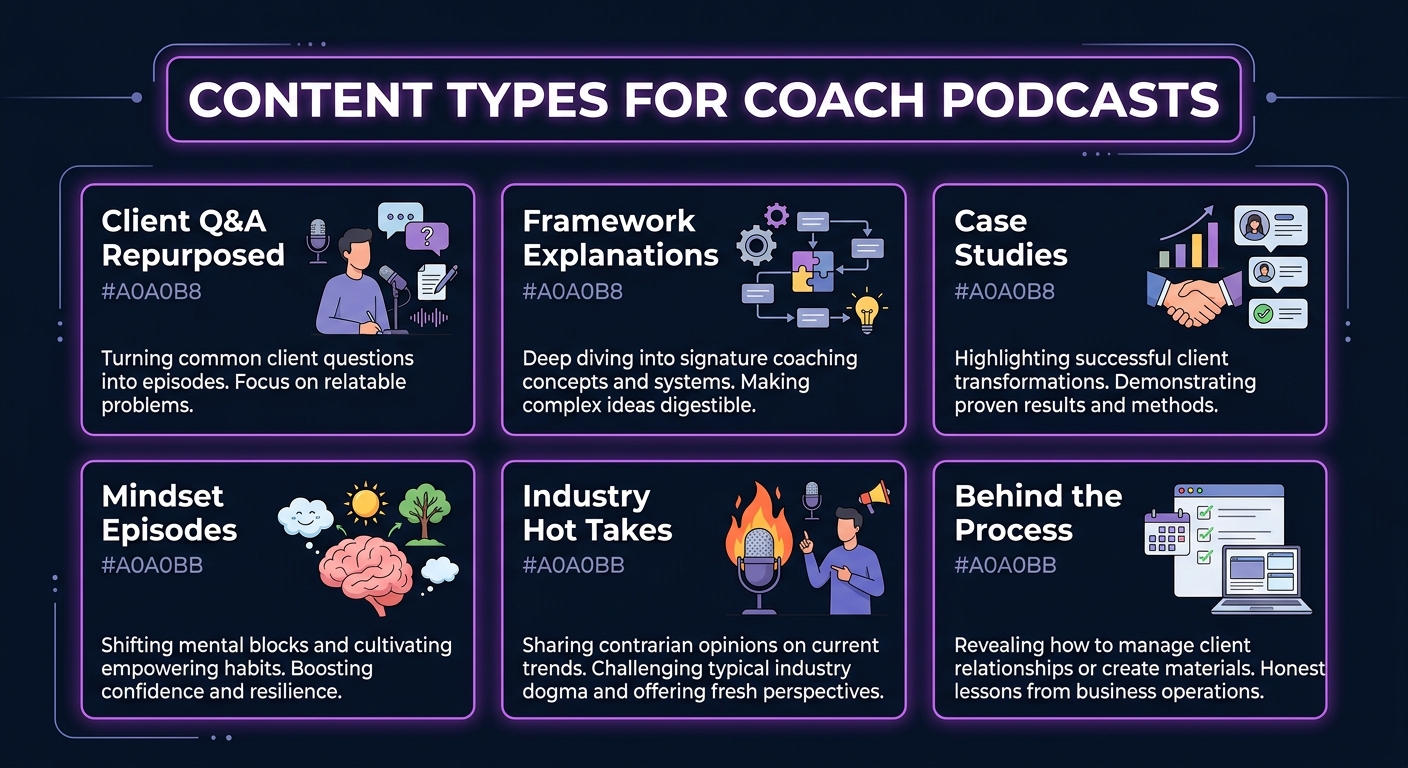
Every coach has recurring questions they answer again and again in discovery calls, onboarding sessions, and client check-ins. These questions are podcast gold — they're exactly what your prospective clients are searching for, and answering them publicly serves two purposes simultaneously: it helps current clients, and it demonstrates your thinking to prospective ones.
The workflow is simple: keep a running list of the best questions clients ask you. When you have 5–8 questions on a theme, input them into PodGorilla as a topic prompt and generate a Q&A episode. You're essentially capturing expertise you're already sharing privately and amplifying it to a public audience.
2. Framework Explanations
Most coaches and consultants work from proprietary frameworks, methodologies, or models they've developed through years of client work. Explaining these frameworks in dedicated episodes — walking through the logic, the steps, the common mistakes — is some of the highest-value content you can produce. It demonstrates intellectual depth, creates memorable positioning, and gives prospective clients a preview of what working with you feels like.
3. Case Studies From Client Work
Anonymized case studies — "A client came to me with this challenge. Here's how we approached it, what we discovered, and what changed" — are among the most compelling podcast episodes a coach can produce. They do everything simultaneously: demonstrate results, explain your methodology, and create emotional resonance through story. Convert your written case studies or client testimonials into podcast episodes using PodGorilla's blog-to-podcast workflow, as described in our guide to turning blog posts into podcasts.
4. Trend and Industry Commentary
Hot takes and contrarian perspectives on industry trends position you as someone with a distinctive point of view — essential for standing out in any coaching or consulting niche. A weekly "my take on what's happening in [your space]" episode builds habitual listening and positions you as a trusted voice in current conversations your ideal clients are already having.
5. Behind-the-Process Episodes
Transparency about how you work — your intake process, how you structure a coaching engagement, how you handle specific client scenarios — reduces the uncertainty that prospective clients feel before booking. These episodes answer the unspoken questions that prevent qualified prospects from reaching out and work as evergreen pre-sales content.
Building a Niche Podcast That Attracts Ideal Clients
The most effective coach podcasts are radically specific. Specificity is counterintuitive — it feels like you're narrowing your audience — but in practice, a highly specific podcast attracts a smaller audience of much more qualified listeners, while a generic podcast attracts a large audience of people who will never buy.
Niche positioning examples that work:
- "The Scaling Coach" (instead of "business coaching for entrepreneurs")
- "Money Mindset for Physicians" (instead of "financial coaching")
- "Executive Transition Playbook" (instead of "career coaching")
- "Agency Owner's Growth Lab" (instead of "marketing consulting insights")
When someone searches Spotify for "scaling a coaching business" and finds your podcast — which has 50 episodes specifically about that topic — you've already won the trust battle before they've heard a word.
Publishing consistency is what turns a niche podcast into a category-defining one. With AI production removing the time barrier, the only remaining obstacle is topic generation — which is solved by systematically converting your client work, email answers, and existing content into episodes on a rolling basis.
Monetization: Turning Listeners Into Clients
The primary monetization mechanism for coach and consultant podcasts isn't ad revenue — it's client acquisition. The show notes and episode outro are your primary conversion surfaces:
- Show notes CTA: Every episode description includes a direct link to your discovery call booking page or lead magnet. Listeners who want to go deeper have a clear, frictionless next step.
- Episode outro: The last 60–90 seconds of every episode is your "commercial break" — a consistent, low-pressure invitation to book a call or download a resource. Use PodGorilla's intro/outro feature to record this once and apply it to every episode.
- Lead magnets tied to episodes: Offer a free resource (worksheet, framework PDF, checklist) related to the episode topic in exchange for an email address. The listener's context — they just consumed 20 minutes of your thinking on this exact topic — makes them highly likely to opt in.
- Workshop and course promotion: Podcasts are excellent channels for promoting cohort-based programs and online courses. A dedicated episode on the problem your program solves, followed by a specific CTA for enrollment, consistently outperforms email or social promotion alone.
For coaches considering whether to also explore traditional recording options before going fully AI, the best AI podcast tools comparison lays out the full landscape. And for a look at distribution options once you're publishing, this guide to publishing on Spotify covers the setup process end to end.
Frequently Asked Questions
How long does it take to start getting clients from a podcast?
Most coaches begin seeing inbound inquiries that reference their podcast after 3–6 months of consistent weekly publishing. The timeline depends heavily on niche specificity, episode quality, and how actively you promote each episode through email and social channels. Coaches who systematically convert their best episode content into social clips and email content tend to see faster results because they drive existing audiences to the podcast rather than relying entirely on organic platform discovery.
Should I use my real voice or an AI voice for my coaching podcast?
Both work. Using PodGorilla's voice cloning feature to replicate your own voice from 60 seconds of audio gives you the authority of a personal voice without the recording requirement. If you prefer using a standard AI voice, choose one that fits the tone of your brand — warm and conversational for life/executive coaching, authoritative and precise for strategy consulting. Consistency matters more than whether the voice is technically human or AI.
How do I come up with enough topics to publish weekly?
Start with a topic bank built from: (1) every question you've answered in the last 90 days for clients or prospects, (2) every objection you hear on discovery calls, (3) your framework's core concepts (one episode per step), and (4) common misconceptions in your field. Most coaches find they can identify 50–80 topics in a single 30-minute brainstorm — enough for a year of weekly episodes without repeating.
Can I use PodGorilla to convert my existing blog or newsletter into podcast episodes?
Yes. PodGorilla accepts blog URLs, YouTube URLs, PDFs, and pasted text as input. If you have an existing content library — even just 10–20 blog posts — you have a ready-made back-catalog of podcast episodes. This is the fastest way to launch: publish your converted back-catalog as a batch, then maintain weekly production going forward.
Is it ethical to use AI to produce a coaching podcast?
Yes, and an increasing number of coaches are transparent about it. The value in a coaching podcast is the ideas, frameworks, and expertise — not the act of recording. AI is a production tool, like a microphone or an audio editor. What you're delivering to listeners is your thinking, your methodology, and your unique perspective — that's entirely yours regardless of how it's narrated.
What's the difference between a podcast and a webinar for client acquisition?
Webinars require a significant time commitment from attendees (usually 60–90 minutes at a specific time), have high drop-off rates, and don't compound — once it's over, the audience exposure ends. Podcasts are consumed at the listener's convenience, can be 15–30 minutes, and compound indefinitely as your back-catalog grows. A webinar might reach 50–200 people live. That same 60-minute content investment in a podcast back-catalog continues reaching new listeners every month for years.