AI podcast generators have fundamentally changed who can create a podcast. What once required a recording studio, professional microphone, audio editor, and hours of production time can now be done by anyone, in minutes, using nothing but a laptop and an idea. This guide explains exactly what AI podcast generators are, how they work, what features matter, and how to choose the right one.
What Is an AI Podcast Generator?
An AI podcast generator is a platform that uses large language models (LLMs), text-to-speech (TTS) synthesis, and audio production automation to create podcast episodes from written or digital content.
You provide an input — a blog post URL, a PDF, a YouTube video link, a keyword, or a custom topic — and the platform handles everything else:
- Researching and writing the podcast script
- Assigning AI voices to each speaker/host/guest
- Generating realistic speech audio from the script
- Producing the final audio file (MP3/WAV)
- Optionally creating a video version for YouTube and social
- Publishing directly to Spotify, Apple Podcasts, YouTube, and other platforms
The result is an episode that sounds like it was recorded by real people, produced in under 10 minutes.
How AI Podcast Generators Work
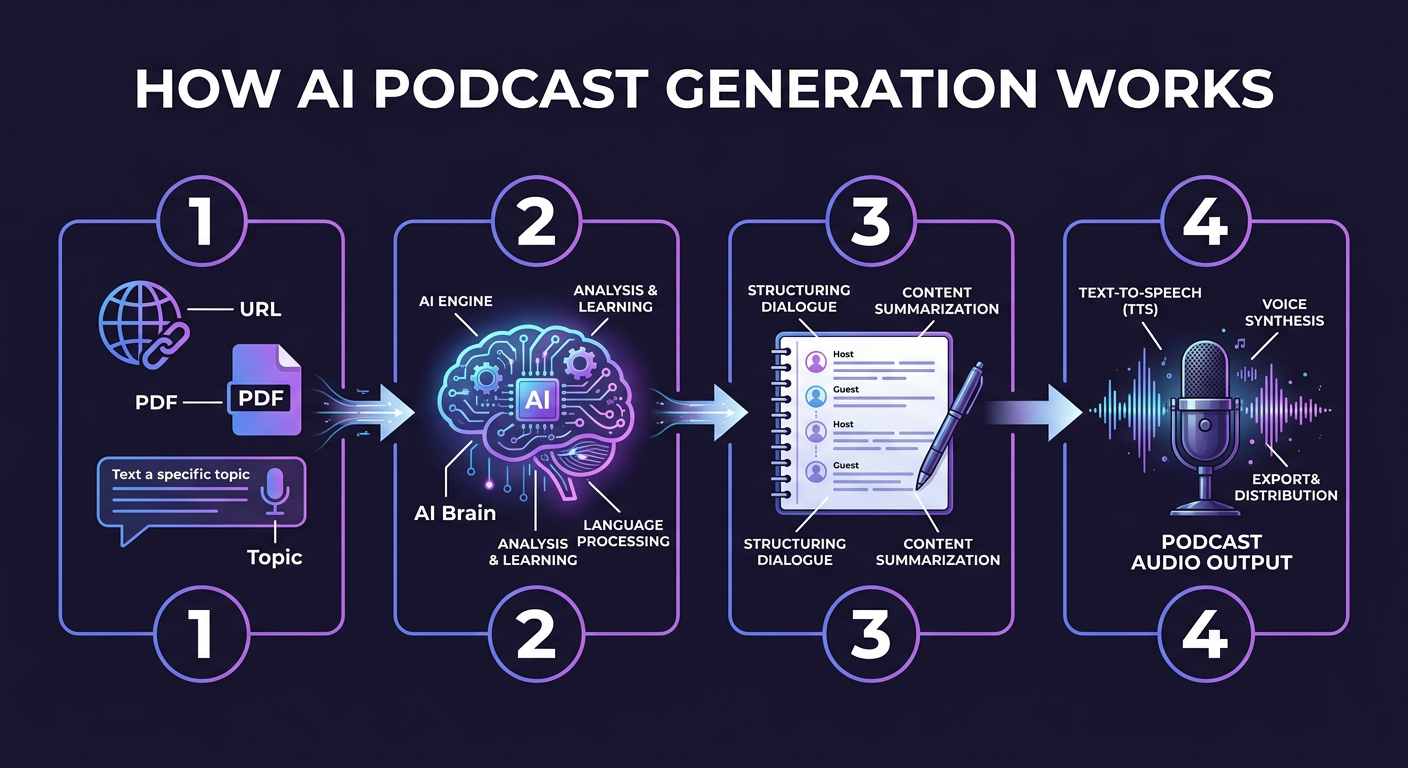
The process typically follows four stages:
1. Content Ingestion
The AI reads your input source — a URL is fetched and parsed, a PDF is extracted, a YouTube video is transcribed, or a topic prompt is expanded using the platform's LLM. This becomes the raw knowledge base for the episode.
2. Script Generation
The LLM writes a podcast script from the content. Depending on the format you choose — interview, solo commentary, debate, news briefing — the script is structured accordingly. Good platforms let you edit this script before generating audio, so you keep full control of what's said.
3. Voice Synthesis
Text-to-speech AI converts each line of the script into audio. Modern TTS models (like those from ElevenLabs, Google WaveNet, or proprietary systems) produce voices that include natural prosody, pauses, emphasis, and emotion — making them nearly indistinguishable from human recordings in double-blind tests.
4. Production & Distribution
The audio segments are assembled, intro/outro music optionally added, and the episode exported. Advanced platforms like PodGorilla then publish directly to all major podcast directories via RSS, embed the episode in a video format for YouTube, and create short clips for TikTok and Instagram — all from the same workflow.
Key Features to Look For
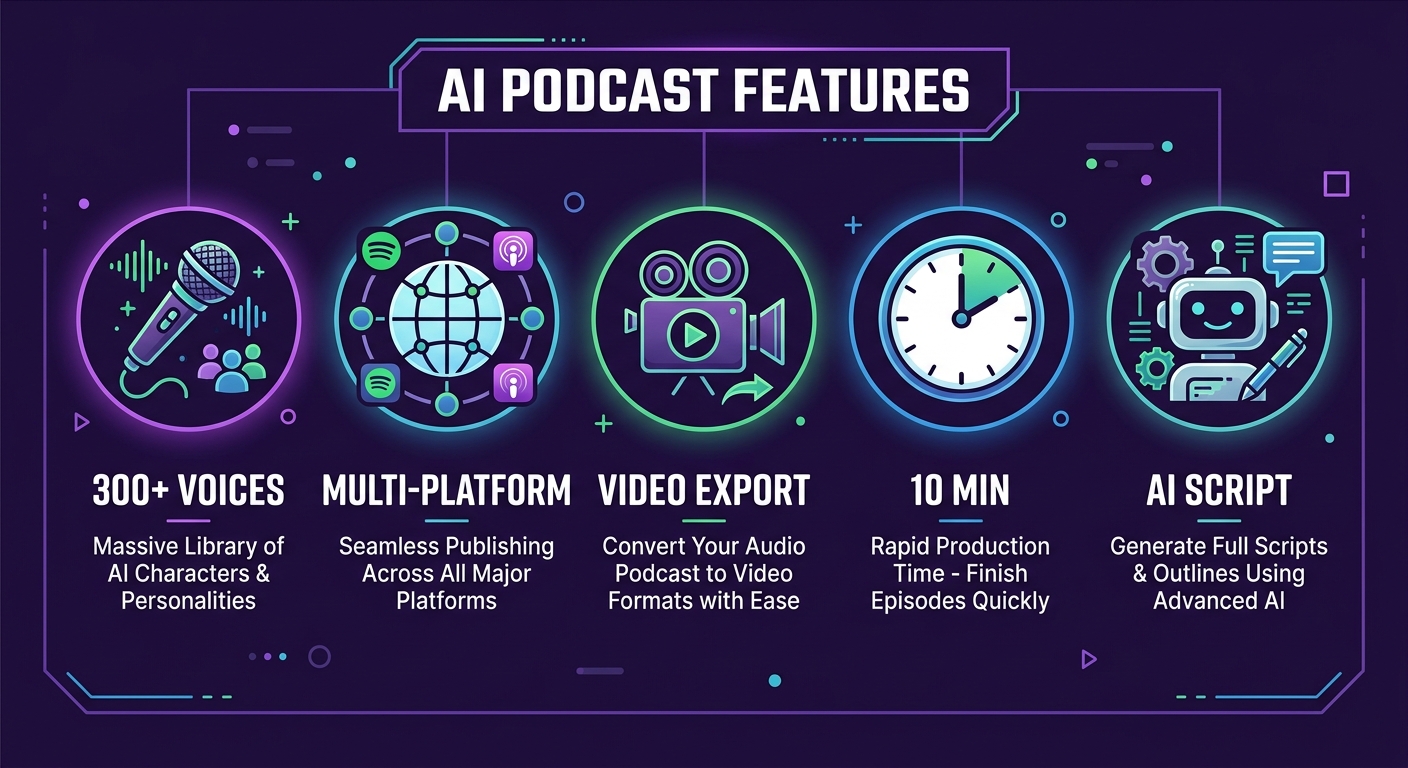
Not all AI podcast generators are equal. Here's what separates the best from the rest:
| Feature | Why It Matters | What to Look For |
|---|---|---|
| Voice quality & variety | Determines how human the podcast sounds | 300+ voices, multiple languages, natural prosody |
| Input flexibility | More input types = more content you can repurpose | URL, PDF, YouTube, topic, custom script |
| Script editing | Lets you fix AI errors before generating audio | Inline editor with per-line regeneration |
| Podcast styles/formats | Different formats suit different audiences | Interview, solo, news, storytelling, panel |
| Video export | YouTube is now the #1 podcast platform for 18–34s | 16:9, 9:16, 1:1 with animated captions |
| Multi-platform publishing | Reach listeners wherever they are | Spotify, Apple, YouTube, TikTok, LinkedIn, Instagram |
| Voice cloning | Lets you sound like yourself | 60-second upload to clone any voice |
| Production speed | Determines how much content you can create | Under 10 minutes per episode |
Who Uses AI Podcast Generators?
AI podcast generators are used across a wide range of industries and roles:
- Content creators and bloggers — repurposing written content into audio without additional production effort. See our guide on how to turn a blog post into a podcast.
- Marketers and brands — creating branded audio content at scale for lead generation and audience building. Learn more in our guide on AI podcasting for marketers.
- Educators and course creators — converting lesson materials, syllabi, and PDFs into audio learning experiences students can consume anywhere.
- Coaches and consultants — building thought leadership through consistent audio content without the time overhead of traditional podcast production.
- Businesses and agencies — producing internal content, client deliverables, or white-labeled podcast series at scale.
- YouTubers and video creators — extracting podcast episodes from existing video content and distributing to audio-first platforms.
"AI voice technology has matured to the point where the gap between synthetic and human audio is imperceptible to most listeners. We're entering an era where the bottleneck in podcasting is ideas, not production."
— Edison Research, Infinite Dial 2025 Commentary
Benefits of AI Podcast Generators
- Speed: From idea to published episode in under 10 minutes, vs. 4–8 hours for traditional production workflows.
- Cost: Eliminate studio rental, equipment, and editing costs. PodGorilla starts at $1 for a full trial.
- Consistency: Publish on a regular schedule without burning out — AI doesn't have bad voice days or schedule conflicts.
- Scale: Create one episode or 100. The time investment is the same per episode regardless of volume.
- Repurposing: Every blog post, PDF, or video you've ever created is now potential podcast content.
- Multi-format output: Get audio, video, transcripts, and social clips from a single production run.
Limitations to Be Aware Of
AI podcast generators are powerful but not perfect. Here's what to keep in mind:
- Factual accuracy: AI scripts can hallucinate details, especially for niche or highly technical topics. Always review the script before publishing.
- Emotional nuance: While voice quality has improved dramatically, AI voices can still struggle with complex emotional delivery compared to trained human narrators.
- Audience authenticity: Some listeners prefer knowing they're listening to a real human. For personal brand-driven podcasts, consider using voice cloning with your own voice rather than fully synthetic personas.
- Creative direction: The AI follows your input — the better your brief, the better the output. Garbage in, garbage out still applies.
How to Get Started With an AI Podcast Generator
Getting your first AI-generated episode live is straightforward:
- Choose a platform — see our roundup of the best AI podcast tools in 2026.
- Pick your input — a blog post URL, PDF, YouTube video, or a topic you want to cover.
- Select your format — interview with two hosts, solo commentary, news briefing, or storytelling.
- Choose your voices — select from premade AI personas or clone your own voice.
- Review and edit the script — catch any errors or adjust the tone before generating audio.
- Generate and publish — export MP3 and video, then publish to all platforms in one click.
PodGorilla does all of this in under 10 minutes. With 300+ premium AI voices, 12+ podcast styles, and one-click publishing to Spotify, Apple Podcasts, YouTube, TikTok, Instagram, and LinkedIn — it's the most complete AI podcast generator available. Start for $1 →
Frequently Asked Questions
What is an AI podcast generator?
An AI podcast generator is a tool that uses artificial intelligence to automatically create podcast episodes from text, URLs, PDFs, YouTube videos, or topic prompts. It handles scriptwriting, voice synthesis, audio production, and publishing — without requiring a microphone, recording studio, or editing software.
Can AI generate a full podcast episode?
Yes. Modern AI podcast generators like PodGorilla can produce a complete, broadcast-quality podcast episode — including script, realistic AI voices, and final audio/video export — in under 10 minutes from a single input like a blog post URL or topic keyword.
Do AI podcast voices sound real?
High-quality AI voices today are nearly indistinguishable from human recordings in blind listening tests. Multiple academic studies published in 2024–2025 show that listeners cannot reliably identify AI voices vs. human voices when the voice quality is sufficiently advanced. PodGorilla uses 300+ premium AI voices trained on professional voice actors.
Is AI podcasting legal?
Yes, using AI to generate podcast content is legal. You own the output of AI tools you use through licensed platforms. However, you should ensure any source content you input (URLs, PDFs) is content you have rights to repurpose, and always disclose AI-generated content where required by platform policies.
How much does an AI podcast generator cost?
Costs vary widely. Free tiers typically limit episode length, voice quality, or number of exports. Paid plans range from $10 to $100+ per month depending on features. PodGorilla offers a full-featured trial for $1, giving you access to all voices, formats, and publishing integrations.
What is the best AI podcast generator in 2026?
PodGorilla is among the most comprehensive AI podcast generators in 2026, offering 300+ AI voices, 12+ podcast styles, voice cloning, video export in three formats, and direct publishing to Spotify, Apple Podcasts, YouTube, TikTok, LinkedIn, and Instagram — all from a single workflow. See the full comparison in our best AI podcast tools guide.