The podcast industry holds 584.1 million listeners worldwide and is growing at 27% annually toward a projected $131 billion by 2030 — yet the median podcast has fewer than 150 downloads per episode. The gap between podcasts that grow and those that stall is rarely about content quality. It's about distribution strategy, publishing consistency, and discoverability. This guide breaks down the 10 strategies that actually move the needle, with specific tactics for each and how AI tools make them faster to execute.
The Podcast Growth Reality
Before the strategies, the context: podcast growth is hard, but it's also predictable. The shows that grow are almost always doing a specific set of things consistently. The shows that stall have typically skipped one or more of these fundamentals.
| Podcast Milestone | % of All Podcasts | What They're Typically Doing Right |
|---|---|---|
| Under 100 downloads/episode | ~65% | Publishing inconsistently, on 1–2 platforms, no SEO, no video |
| 100–1,000 downloads/episode | ~25% | Consistent publishing, basic multi-platform, some community |
| 1,000–10,000 downloads/episode | ~8% | Strong niche, video clips, active cross-promotion, SEO-optimized |
| 10,000–100,000 downloads/episode | ~1.5% | All 10 strategies consistently executed, strong brand |
| 100,000+ downloads/episode | ~0.5% | All of the above + significant PR, advertising, or celebrity factor |
The jump from under 100 to 100–1,000 downloads is primarily about fixing distribution and consistency. The jump from 1,000 to 10,000 requires adding active discoverability channels (video, SEO, cross-promotion). Everything above that adds audience development sophistication on top of the fundamentals.
"Consistency is the single most reliable predictor of podcast growth. Shows that publish on a fixed schedule — weekly, bi-weekly — consistently outperform shows with better production quality that publish irregularly. Listeners build habits around shows that show up reliably."
— Edison Research, The Podcast Consumer 2025
10 Proven Podcast Growth Strategies
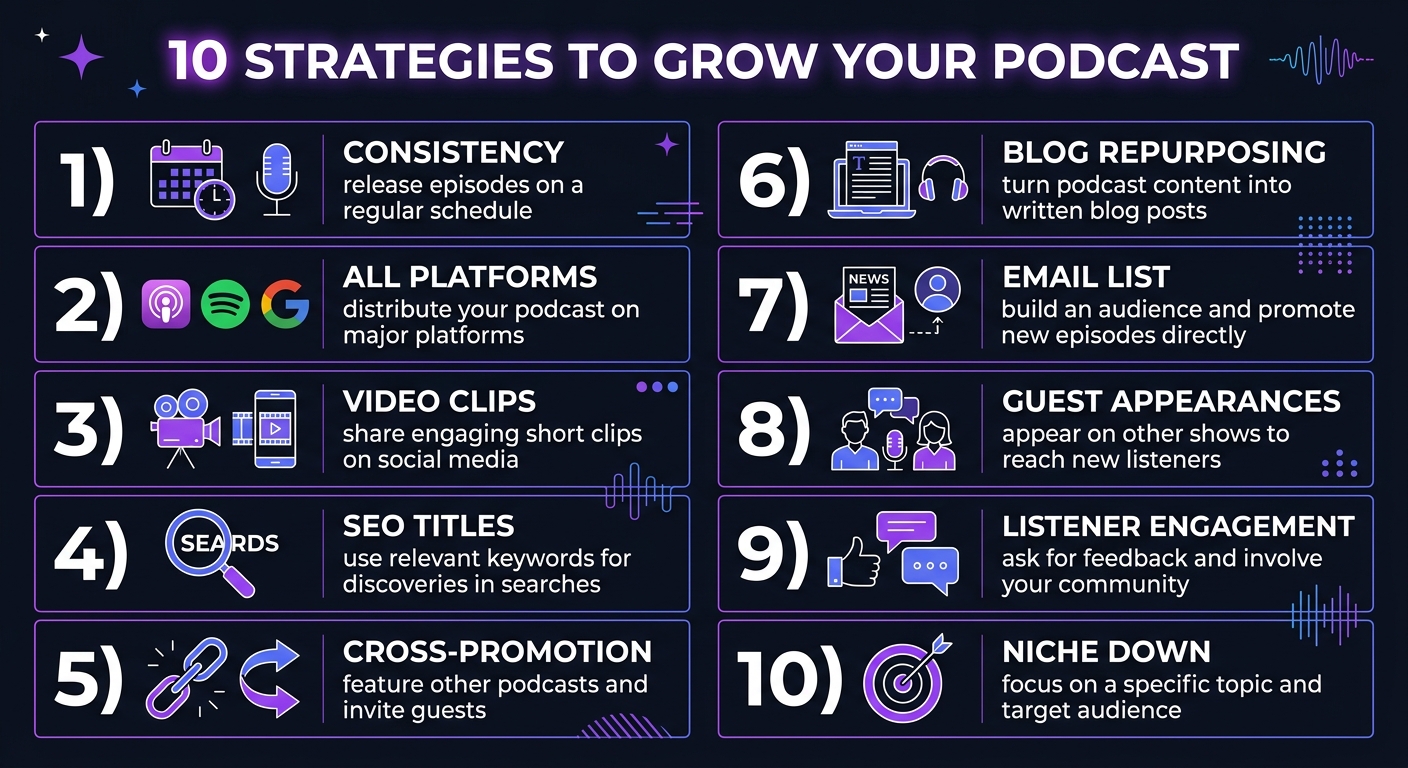
Strategy 1: Consistency Over Quality
This is the most important and most under-practiced principle in podcasting. A good episode published every week will outperform a great episode published whenever you get around to it. Why? Because podcast app algorithms reward shows that publish regularly, listeners build habits around consistent schedules, and search directories give more weight to active shows.
Set a publishing frequency you can maintain indefinitely — not a frequency that's aspirational but unsustainable. If weekly is too fast, bi-weekly is fine. If you can only do monthly, commit to it. AI podcast generators like PodGorilla make consistency dramatically easier — you can go from topic to published episode in under 10 minutes, which eliminates the production bottleneck that usually causes irregular publishing.
Strategy 2: Publish on All Platforms Simultaneously
Being available on only one or two platforms artificially caps your potential audience. As shown in the podcast distribution guide, being on Spotify and Apple Podcasts alone only reaches about 48% of the podcast-listening audience. Adding YouTube, Amazon, and iHeart pushes that to over 82%.
Use RSS-based distribution so that a single publish action updates all audio platforms automatically, and use a platform like PodGorilla that additionally publishes video versions to YouTube, TikTok, LinkedIn, and Instagram in the same workflow.
Strategy 3: Video Clips for TikTok, Instagram, and YouTube Shorts
Short-form video is the highest-ROI podcast discovery channel available in 2026. A 60-second clip from your episode — showing a compelling moment, a counterintuitive insight, or a shareable reaction — can reach thousands of non-subscribers on TikTok and Instagram Reels through algorithmic distribution that audio directories simply don't provide.
The math: a podcast episode with 200 audio downloads might generate a TikTok clip that gets 15,000 views, converting 3–5% of those viewers to podcast subscribers. That's 450–750 new listeners from a single clip. Do this consistently across 50 episodes and the compounding effect is significant.
PodGorilla generates 9:16 vertical video clips from every episode automatically — no video editing required. The clip is ready to upload to TikTok, Instagram, and YouTube Shorts as part of the standard episode workflow.
Strategy 4: SEO-Optimized Episode Titles and Descriptions
Spotify, Apple Podcasts, and especially YouTube have search engines. People actively search for podcasts about their interests. Episode titles and descriptions are the primary signal these search engines use to match your content to listener queries.
SEO title principles for podcasts:
- Lead with the keyword or topic, not your podcast name. "The Joe Smith Show, Ep. 47" has no search value. "How to Build a Morning Routine That Actually Sticks" does.
- Include the year for evergreen topics: "Best AI Tools for Content Creators (2026)"
- Be specific: "How to Grow a Podcast" is competitive; "How to Grow a Podcast Audience to 10,000 Downloads" is more targeted and more useful to a searcher.
- Write your episode description (show notes) as a 150–300 word summary with natural keyword inclusion — not a bullet list of timestamps only.
AI tools can help with this: AI podcast script generators can suggest SEO-optimized titles based on your episode topic, and the episode description can be auto-generated from the script.
Strategy 5: Cross-Promotion With Other Shows
Guest exchanges — appearing on another podcast as a guest, with the host returning the favor — remain one of the highest-conversion growth tactics available. When you appear on a show with 2,000 weekly listeners in your niche, you're being introduced to an already-qualified audience by a trusted voice (the host).
How to execute:
- Find shows in adjacent niches (same audience, different angle) with similar audience size using tools like Rephonic or Listen Notes
- Pitch a specific, valuable angle — not "I'd love to be on your show" but "I could talk about X, which your audience would find valuable because..."
- Aim for feed swaps: host their episode on your feed in exchange for hosting your episode on theirs. No recording needed — pure audience exchange.
Strategy 6: Repurpose Episodes as Blog Posts
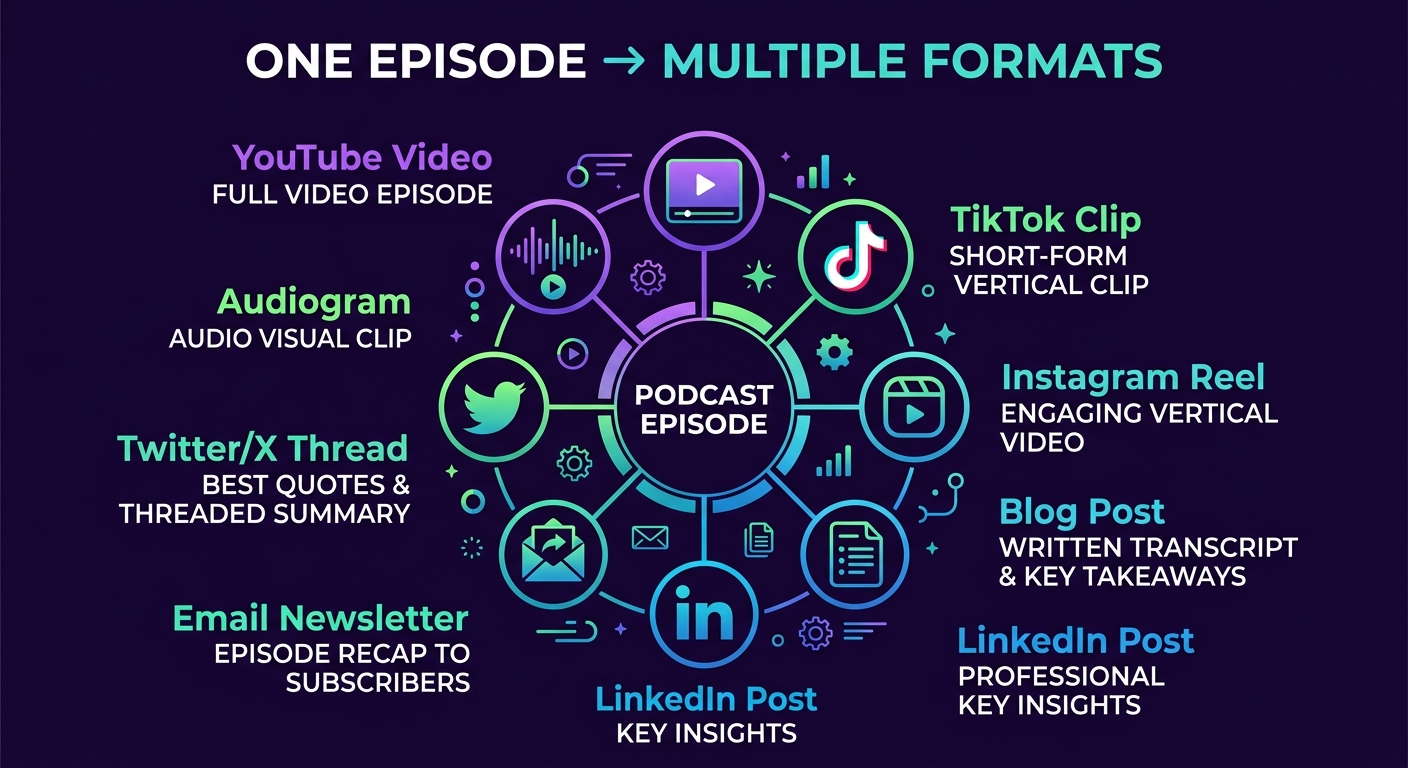
Every episode you produce is also a piece of long-form content. Converting your episode into a blog post — a transcript-based article, a summary post, or a companion deep-dive — creates a second discovery surface through Google Search.
This is particularly powerful for educational, how-to, and definition-style content. Someone searching Google for "how to start a podcast without a microphone" might find your blog post, read it, and then subscribe to the podcast. The blog post feeds the podcast, which feeds the blog through SEO authority.
You can also run this in reverse: use existing blog posts as inputs for new podcast episodes. AI tools make this two-way repurposing extremely fast — a blog post becomes a podcast in minutes, and a podcast transcript becomes a blog post with AI summarization.
Strategy 7: Email List Integration
Email remains the highest-conversion distribution channel for podcast promotion. Listeners who subscribe to your email list are significantly more engaged than passive followers — they're raising their hands as fans. A weekly or bi-weekly email that links to the new episode, includes a compelling preview, and provides additional value (links, thoughts, resources) will consistently drive episode listens from your most loyal audience segment.
Build your email list in parallel with your podcast. Offer a lead magnet related to your niche (a guide, a template, a checklist) and link to it in your episode descriptions and show notes. Even 500 engaged email subscribers will outperform 5,000 passive followers on social in terms of actual listens per episode.
Strategy 8: Guest Appearances on Other Podcasts
Separate from Strategy 5 (cross-promotion as a host), actively pitching yourself as a guest on established podcasts is a scalable growth lever. When you appear as a guest, you:
- Get introduced to an established audience with credibility already built by the host
- Create a backlink to your podcast from the episode show notes (good for SEO)
- Generate a piece of content (the interview) that both you and the host can promote
- Build relationships with other creators who may later reciprocate as guests on your show
Target: aim for 2–4 guest appearances per month, especially in your first year. Use the resulting exposure to funnel listeners back to your own show with a clear call to action at the end of each appearance.
Strategy 9: Listener Engagement
Listeners who engage — who comment, share, reply to your email, or message you — convert other potential listeners through word-of-mouth at a higher rate than any advertising. Building engagement is about making listeners feel like participants, not passive consumers.
Tactics that work:
- End every episode with a specific, answerable question ("What's your version of this? Reply to this week's email.") rather than a generic "leave us a review."
- Read and respond to listener messages in future episodes — this creates a feedback loop that listeners love.
- Run polls in your email newsletter or community about upcoming episode topics, making listeners co-creators of your content calendar.
- Feature listener questions as an episode segment — a "listener mailbag" episode format generates both engagement and content efficiently.
Strategy 10: Niche Down
"Marketing for entrepreneurs" is competing against thousands of shows. "Marketing for solo Etsy shop owners" has far less competition and a highly specific, searchable, shareable identity. The counterintuitive truth in podcasting is that narrower niches grow faster, because word-of-mouth is more targeted ("you HAVE to listen to this podcast, it's exactly for people like us") and search discovery is more efficient.
Niche down on audience (who you serve), topic (what specific problem you solve), or format (how you deliver it) — or ideally all three. You can always broaden over time as your authority grows. Starting broad makes everything harder: content development, discoverability, and listener loyalty.
How AI Tools Accelerate Every Strategy
The 10 strategies above are not new. What's new in 2026 is that AI tools have removed the production bottleneck that prevented most creators from executing them consistently:
| Strategy | Traditional Time Cost | With AI Tools |
|---|---|---|
| Episode production (consistency) | 4–8 hours/episode | Under 10 minutes |
| Video clip creation | 1–2 hours per clip | Auto-generated with episode |
| SEO-optimized title/description | 20–30 min research + writing | AI-generated from script in seconds |
| Blog post from episode | 2–3 hours writing | AI summarization in minutes |
| Multi-platform publishing | 30–60 min manual uploads | One-click to 6 platforms |
| Episode script writing | 3–6 hours | Under 60 seconds with AI |
PodGorilla is built to execute every one of these accelerations in a single workflow. From topic to published everywhere in under 10 minutes means a weekly podcast becomes a realistic, sustainable commitment — not a full-time job. Explore the full feature set on the features page or check out the best AI podcast tools comparison for 2026. Start for $1 →
Frequently Asked Questions
How long does it take to grow a podcast audience?
Most podcasts that grow consistently reach 100–500 downloads per episode within 6–12 months of consistent weekly publishing. Reaching 1,000+ downloads per episode typically takes 12–24 months with active cross-promotion and video distribution. Viral growth can compress these timelines significantly, but sustainable growth is more predictable through consistent execution of the fundamentals than through viral hits.
What is a good number of podcast listeners?
Context matters enormously. For a niche B2B podcast targeting a specific professional audience, 500 highly engaged downloads per episode can represent a significant, monetizable audience. For a general interest podcast, 1,000+ downloads per episode is typically the threshold where advertising becomes viable. The "top 10%" of all podcasts globally reaches approximately 150+ downloads per episode — so even modest numbers represent real achievement.
Does publishing on more platforms help podcast growth?
Yes, materially. Being available on Spotify, Apple Podcasts, YouTube, Amazon Music, and iHeart covers over 82% of the podcast-listening audience. Each additional platform is incremental reach with minimal additional effort when using RSS-based distribution. YouTube in particular adds algorithmic discovery that audio-only directories cannot provide — it's now the top podcast platform for 18–34 year olds in the U.S.
How important are podcast reviews for growth?
Reviews on Apple Podcasts have diminishing algorithmic impact compared to previous years — Apple's podcast charts are now more heavily influenced by recent listens, follows, and completion rates than by raw review counts. Reviews still matter for social proof (convincing new listeners to try your show) and for New & Noteworthy consideration, but they should not be your primary growth metric. Focus on follower count and listen-through rate.
Should I pay for podcast advertising to grow my audience?
Paid podcast advertising (running pre-roll or mid-roll ads on other podcasts, or using Spotify's podcast ad network) can be effective but has high minimum costs and uncertain conversion rates for new shows. Most growth experts recommend maxing out free organic strategies first — cross-promotion, guest appearances, video clips, SEO — before investing in paid promotion. Organic growth builds a more loyal audience than paid, and costs nothing but time (which AI tools dramatically reduce).
How do AI tools help with podcast growth?
AI podcast platforms like PodGorilla eliminate the production bottleneck that causes most shows to publish inconsistently. By reducing episode production from 4–8 hours to under 10 minutes, AI enables weekly publishing without burnout. Auto-generated video clips fuel TikTok and YouTube discovery. AI-generated show notes and SEO titles improve search discoverability. And one-click multi-platform publishing ensures every episode reaches the full available audience. All 10 growth strategies become easier to execute consistently when production overhead is removed.