Writing a podcast script from scratch is time-consuming — researching the topic, structuring the argument, writing natural-sounding dialogue, and editing for flow and accuracy can take 3–6 hours for a 30-minute episode. AI podcast script generators collapse that to under a minute. This guide explains exactly how they work, what quality to expect, how to write better prompts to get better scripts, and how to review AI-generated scripts before you hit publish.
What Is an AI Podcast Script Generator?
An AI podcast script generator is a software tool that uses large language models — the same underlying technology as ChatGPT, Claude, or Gemini — trained and prompted specifically to produce podcast-formatted dialogue. It is not a general-purpose chatbot. A good AI script generator is optimized for:
- Understanding source content deeply enough to accurately represent it
- Structuring content in a podcast format (not an essay, not a listicle)
- Writing dialogue that sounds like real people speaking, not reading
- Differentiating between host voices/personalities when a multi-host format is selected
- Calibrating depth, length, and tone to the selected podcast style
As part of an AI podcast generation workflow, the script generator is the first production step — and because everything downstream (voice synthesis, audio quality, listener experience) depends on the script, it's arguably the most important one.
How AI Podcast Script Generation Works
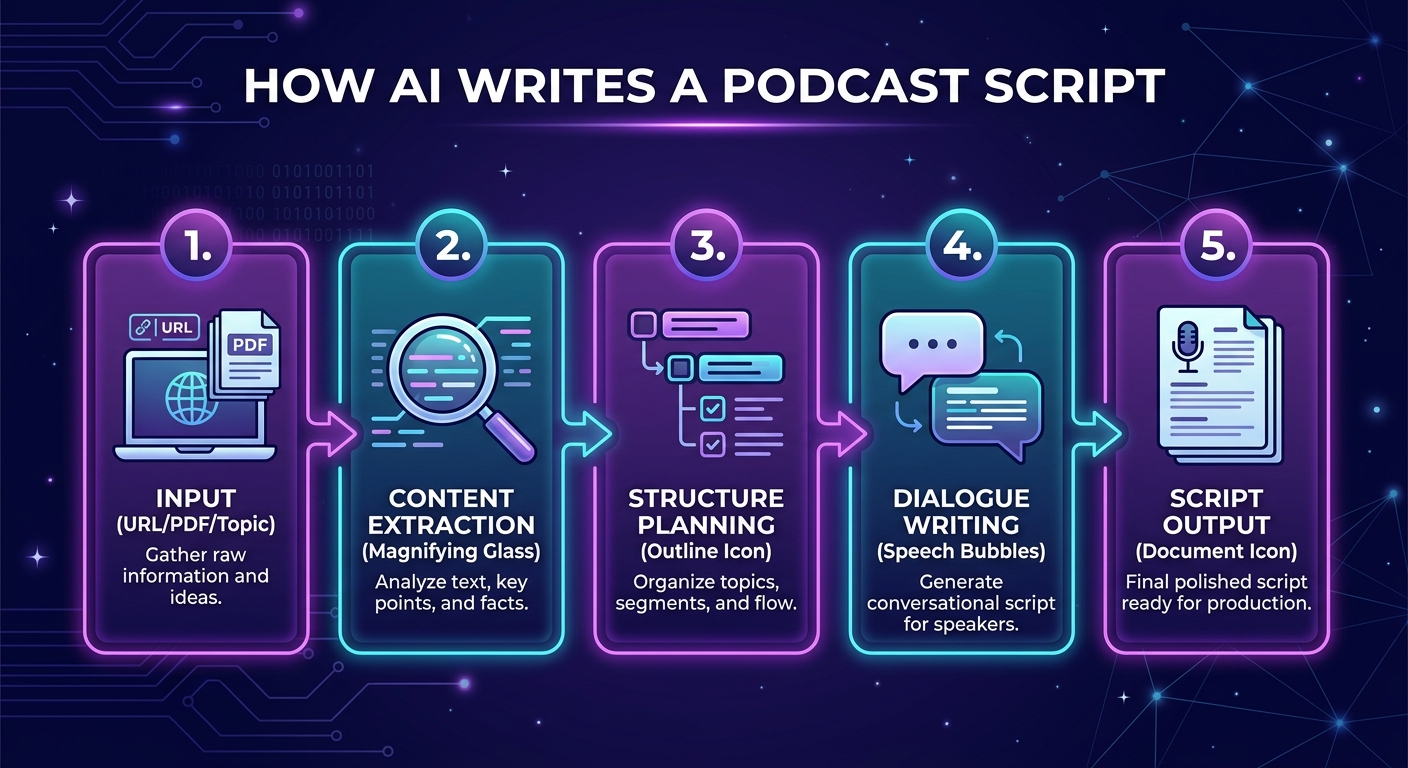
The process behind an AI podcast script generator involves several sequential operations, each handled by different components of the AI system:
Stage 1: Content Ingestion and Extraction
When you provide a URL, the system fetches the page and extracts the main content, stripping navigation menus, ads, and boilerplate. For PDFs, text is extracted using optical character recognition (OCR) or direct text layer parsing. For YouTube videos, the video's automatically generated transcript or closed captions are retrieved. For topic prompts, the LLM draws on its training data and, in advanced platforms, performs real-time web retrieval (RAG — retrieval-augmented generation) to gather current facts.
This extracted content becomes the factual grounding for the script. A well-designed system will not hallucinate beyond this source material — though all AI systems should be reviewed for accuracy.
Stage 2: Format and Structure Planning
Before writing dialogue, the LLM plans the episode's architecture based on the selected podcast style. A Joe Rogan-style long-form interview has a different structure than a 10-minute news briefing or a crime story narrative. The planner determines: episode length, segment breakdown, number of speakers, key talking points per segment, and the narrative arc (hook → development → insight → takeaway).
Stage 3: Dialogue Writing
The LLM generates the actual script, line by line, for each speaker. This is where the quality of the underlying model matters most. Good AI dialogue:
- Uses contractions, hedges, and informal phrasing ("I think," "you know," "right?")
- Includes follow-up questions that feel genuinely curious, not scripted
- Avoids bullet-point-style recitation of facts — it weaves them into conversation
- Gives each speaker a distinct voice: the interviewer asks; the expert explains; the co-host reacts
- Uses natural transitions between topics rather than abrupt jumps
Stage 4: Review and Refinement
On PodGorilla, the generated script is displayed in an editable interface before audio synthesis begins. This is your opportunity to correct factual errors, adjust tone, add personal anecdotes, or change phrasing that doesn't sound like you. You can regenerate individual lines or entire segments without re-running the full generation.
What Makes a Good AI-Generated Script
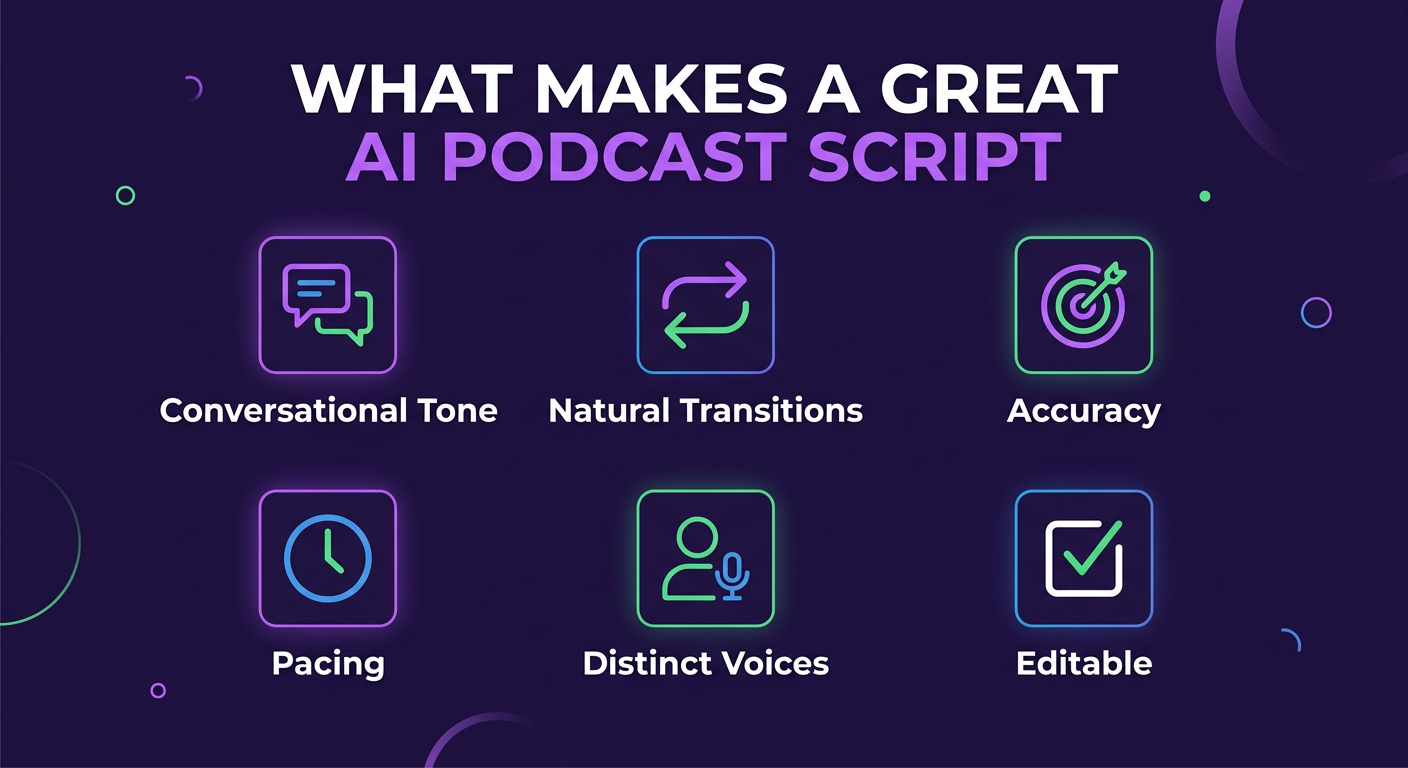
Not all AI scripts are equal. These are the factors that separate broadcast-quality AI scripts from generic AI text:
| Quality Factor | What It Means | How to Check It |
|---|---|---|
| Conversational tone | Sounds like speech, not writing. Includes contractions, informal phrasing, natural hesitations. | Read it aloud. Does it feel natural? |
| Factual accuracy | Statistics, names, and claims match the source material. | Cross-check any specific numbers or claims against the original source. |
| Distinct speaker voices | Host A and Host B sound and think differently. Not interchangeable. | Remove speaker labels. Can you still tell who's who? |
| Logical flow | Topics connect naturally. Each segment leads to the next. | Does the episode have a beginning, middle, and end? |
| Appropriate length | Content fills the intended runtime without padding or cutting off abruptly. | Read at speaking pace (~130 words/minute) and time it. |
| Format fidelity | Matches the selected style — interview, solo, news, storytelling. | Does the structure match what you selected? |
"The best AI-generated podcast scripts are distinguished not by their factual content — which any model can produce — but by their prosodic design: the rhythms, cadences, and structural surprises that make human conversation compelling to listen to. The models that understand this produce scripts that feel alive."
— Nieman Lab, Harvard University, AI in Audio Journalism (2025)
How to Prompt an AI Script Generator for Better Results
The quality of your AI script is directly proportional to the clarity of your input. Here are the most effective techniques for improving output:
Be Specific About Format and Length
Don't just say "make a podcast about productivity." Say: "Create a 20-minute two-host interview podcast about the Pomodoro Technique. Host 1 is a skeptic; Host 2 is a productivity expert. Keep it conversational and include 3 real-world examples." The more specific your format instruction, the better the structure.
Specify Your Target Audience
Include who you're speaking to: "This is for first-time entrepreneurs who know nothing about financial modeling." This changes vocabulary, assumed knowledge, and the explanatory depth of the script significantly.
Provide Your Tone Reference
If you want a specific feel, name it: "Write this in the style of How I Built This — warm, story-driven, with genuine curiosity." Style references are powerful shortcuts for AI models trained on diverse media.
Give Factual Grounding
If you have specific statistics, quotes, or talking points you want included, add them to your input. AI script generators that accept custom briefs alongside URLs can incorporate your specific data points accurately rather than sourcing their own.
Use the Editing Step
Always review and edit before generating audio. Change any lines that feel stiff, add personal anecdotes the AI can't know, and adjust any facts that are outdated. The AI gives you a strong first draft — treat it like one.
AI Scripts vs. Human-Written Scripts: A Realistic Comparison
AI script generators are powerful but have genuine limitations. Here's an honest comparison:
| Dimension | AI Script Generator | Human Writer |
|---|---|---|
| Speed | Under 60 seconds | 3–8 hours |
| Cost | Included in platform subscription | $50–$500+ per episode |
| Factual accuracy on provided source | High (with review) | High (with research) |
| Original insight and opinion | Limited — reflects training data | High — genuine perspective |
| Personal anecdotes and storytelling | Cannot include unless prompted with specifics | Natural strength |
| Consistency at scale | Excellent — same quality every episode | Variable — depends on writer's day |
| Niche topic expertise | Good for mainstream topics; weaker for cutting-edge niches | Expert writers excel at depth |
| Best use case | High volume, repurposing existing content, education, news | Flagship episodes, complex narrative, personal brand depth |
The most effective workflow combines both: use AI for the structural first draft and factual population, then add human editing for personality, insight, and accuracy. This hybrid approach produces scripts in 20–30 minutes that would take a human writer 4–6 hours solo.
How PodGorilla's Script Generator Works End-to-End
PodGorilla's AI podcast script generator is designed for a complete zero-to-published workflow:
- Input your source — paste a URL, upload a PDF, drop a YouTube link, or type a topic. PodGorilla extracts and indexes the content.
- Select your podcast style — choose from 12+ formats including Interview, Solo Commentary, Panel Discussion, The Daily-style news briefing, Crime Junkie narrative, and more. Each style has its own structural template and dialogue style.
- Configure your hosts — select AI speaker personas or use your cloned voice. Assign personality traits (skeptical, enthusiastic, expert, curious) that the LLM uses to differentiate dialogue.
- Review and edit the script — the full script is displayed in an inline editor. Edit any line, regenerate any section, add custom content.
- Generate audio — once the script is approved, PodGorilla synthesizes voice audio from each line, assembles the episode, and exports MP3/WAV plus video formats.
- Publish everywhere — one-click publishing to Spotify, Apple Podcasts, YouTube, TikTok, LinkedIn, and Instagram. See our podcast distribution guide for how this works.
For content creators who want to turn existing blog posts into podcasts, PodGorilla's script generator is especially powerful — it reads your post URL and produces a natural podcast conversation from the article in under 60 seconds. Start for $1 →
Frequently Asked Questions
What is an AI podcast script generator?
An AI podcast script generator is a tool that uses large language models to automatically write a complete podcast script from an input source such as a URL, PDF, YouTube video, or topic prompt. It structures the content in podcast format — with a hook, segmented discussion, natural dialogue, and outro — and outputs a ready-to-voice script in under 60 seconds.
How accurate are AI-generated podcast scripts?
When grounded in a provided source (a URL or PDF you supply), AI-generated scripts are highly accurate in representing the source content. The risk of hallucination is higher when the AI is drawing on general training data for niche topics. Always review the script for factual accuracy before generating audio, particularly for any specific statistics or claims.
Can I edit the script before generating audio?
Yes — and you should. PodGorilla's script generator displays the full script in an editable interface before audio synthesis begins. You can edit individual lines, regenerate specific sections, add personal anecdotes, or adjust the tone. Audio generation only starts when you're satisfied with the script.
What podcast formats can AI script generators produce?
PodGorilla supports 12+ podcast styles: two-host interview, solo commentary, panel discussion, news briefing (The Daily style), narrative storytelling (Crime Junkie style), business interview, educational explainer, and more. Each style produces a structurally different script appropriate to the format's conventions.
How long does it take to generate a podcast script with AI?
Most AI podcast script generators produce a complete script in 30–90 seconds depending on the input length and episode target duration. A 20-minute episode script (approximately 2,600 words of dialogue) typically generates in under 60 seconds on PodGorilla.
Can AI write a podcast script from a YouTube video?
Yes. PodGorilla accepts YouTube video URLs as input. The platform retrieves the video's transcript, extracts the key content, and generates a podcast script based on the video's material. This is useful for repurposing existing video content into an audio-first podcast format for distribution to Spotify, Apple Podcasts, and other directories.