Podcast marketing has moved from a "nice-to-have" to a core demand-generation channel for B2B and B2C brands alike. But the traditional model — hire a producer, book a studio, edit for hours — doesn't scale with a modern content marketing operation. AI podcasting changes the equation entirely: your existing content becomes on-demand audio, published everywhere your buyers already listen, with zero recording required.
Why Marketers Are Adopting AI Podcasting
The case for podcast marketing is stronger than ever. Podcast audiences have grown to 584.1 million global listeners in 2025, and the format commands attention in ways that blog posts and social media simply cannot. But the real driver for marketing teams isn't reach — it's content efficiency.
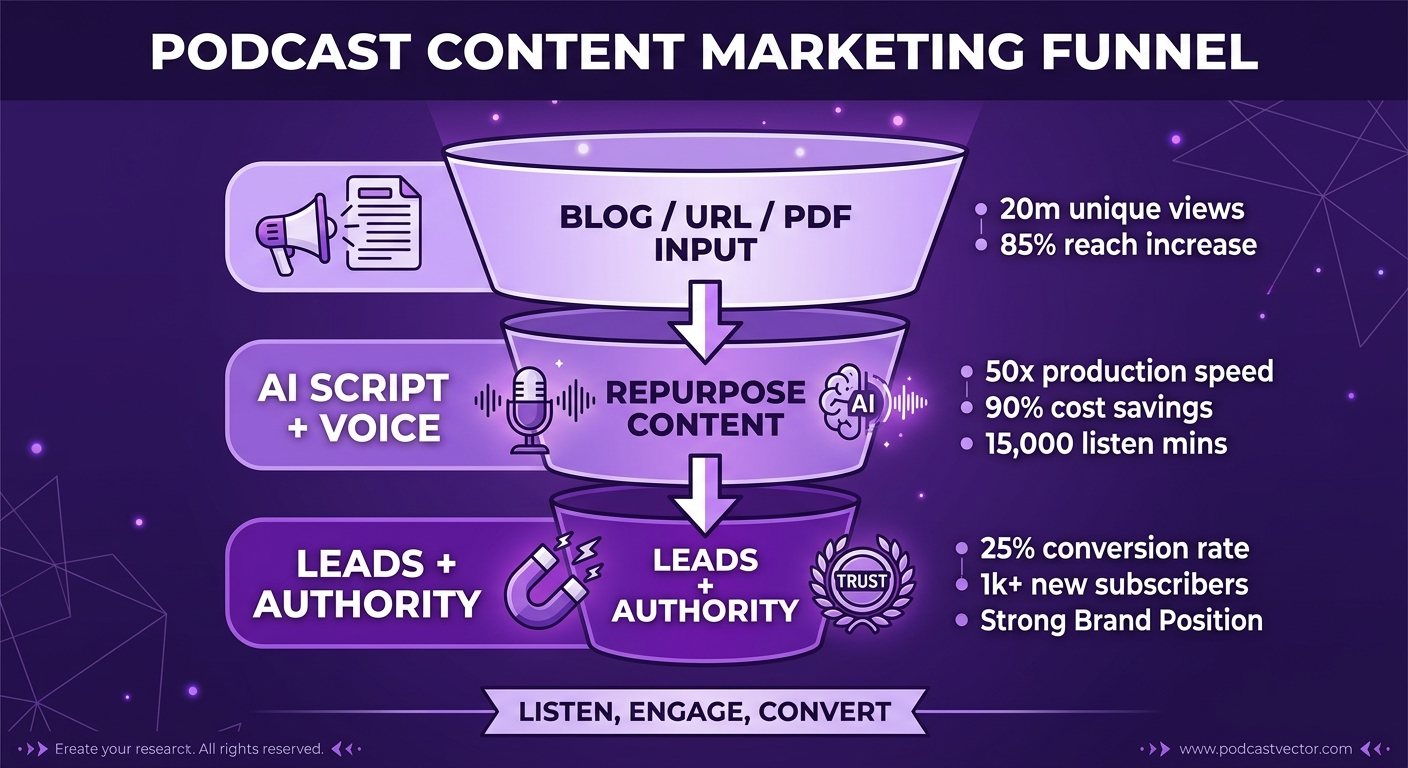
AI podcast generation solves one of the most persistent problems in content marketing: content that gets written once and then dies. A 2,000-word blog post can become a 12-minute podcast episode in minutes. That episode can then become a YouTube video, a LinkedIn native audio post, and a TikTok clip — all without touching a microphone.
Content ROI: Getting More From What You Already Have
HubSpot's 2025 State of Marketing report found that marketers who repurpose content across 3+ formats see 3.5x more organic traffic than those publishing to a single channel. Audio is consistently the most-skipped format in most marketing stacks — not because buyers don't want it, but because production has historically been too expensive and time-consuming to justify.
With AI podcasting, the repurposing math changes dramatically. A content team that publishes 8 blog posts per month can now generate 8 corresponding podcast episodes automatically, each optimized for a different listening context — commute, gym, background research — without adding headcount.
Brand Authority and Share of Voice
Podcasts build the kind of sustained brand trust that display ads and sponsored posts cannot. When a brand's voice shows up consistently in a listener's feed over weeks and months, it creates a parasocial relationship that significantly shortens the sales cycle. Research from Edison Research's Infinite Dial study found that podcast listeners are 20% more likely to follow a brand on social media and 14% more likely to consider a brand's products after regular audio exposure.
B2B Podcast Marketing Statistics
| Stat | Figure | Source |
|---|---|---|
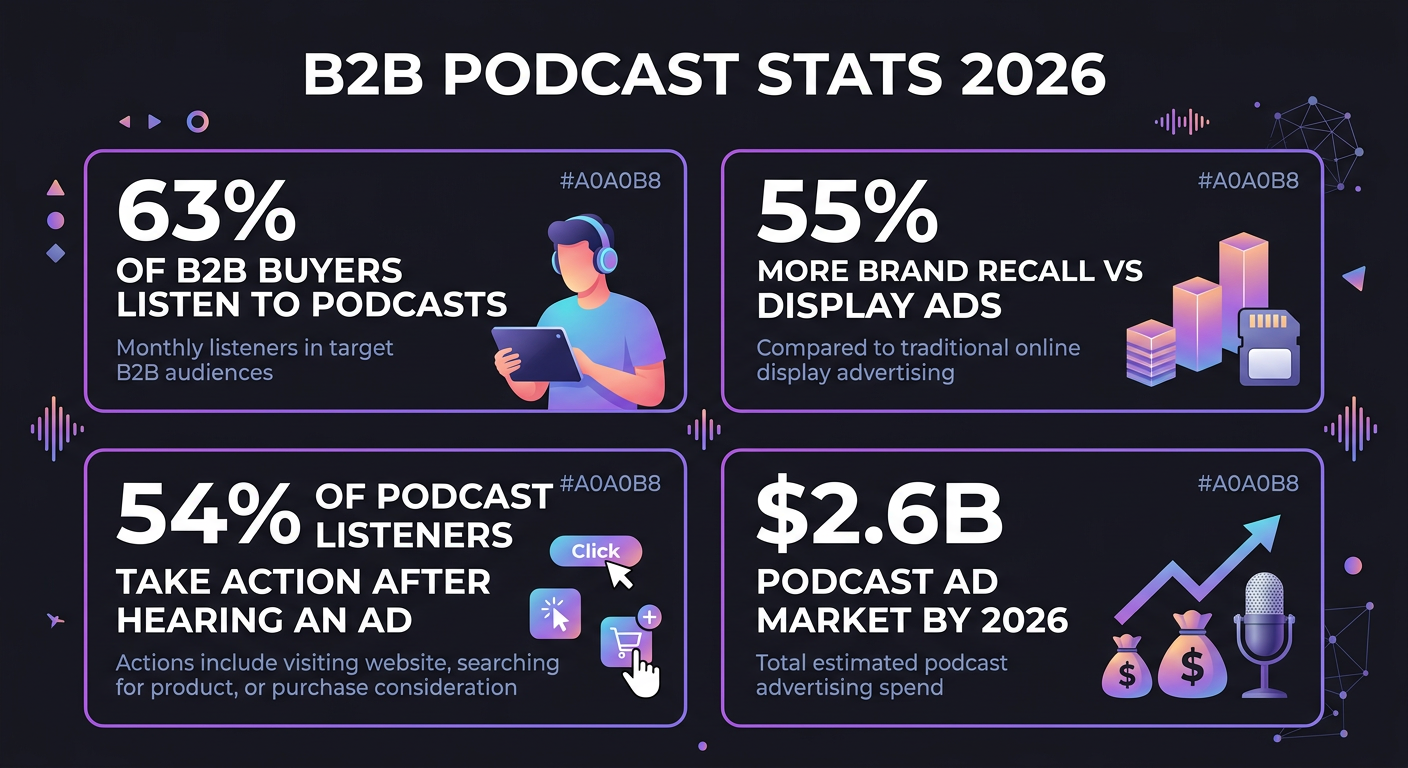
| B2B buyers who regularly listen to podcasts | 63% | Demand Gen Report, 2025 |
| B2B decision-makers who listen to podcasts weekly | 48% | Edison Research, 2025 |
| Brand recall lift vs. display advertising | +55% | Nielsen Audio, 2024 |
| Podcast listeners who take action after hearing an ad | 54% | IAB Podcast Advertising Report, 2025 |
| Average podcast listening time per session | 43 minutes | Spotify Audience Network, 2025 |
| Podcast ad revenue (projected 2026) | $2.6 billion | PwC Global Entertainment, 2025 |
| B2B marketers who say podcasts generate quality leads | 41% | Content Marketing Institute, 2025 |
"Podcasts deliver the longest average engagement time of any content format we track. A well-produced branded podcast can drive 20–40 minutes of brand immersion per session — something no banner ad or social post can match."
— Nielsen Audio Brand Impact Study, 2024
Specific Marketing Use Cases for AI Podcasting
1. Blog Post Repurposing at Scale
The most immediate use case for marketing teams is converting existing blog content into podcast episodes. With PodGorilla's blog-to-podcast workflow, you paste a URL and the AI extracts the key points, structures them into a natural conversation or solo commentary format, and generates a broadcast-quality audio episode — all in under 10 minutes.
This is especially powerful for evergreen SEO content. A pillar page that already ranks for a competitive keyword can now also appear in podcast search results on Spotify and Apple Podcasts, doubling your content's surface area with no additional writing required.
2. Product Update Podcasts
Many SaaS and e-commerce brands publish monthly "changelog" or "what's new" content that rarely gets read. Converting these updates into a 5-minute audio briefing — published to Spotify and delivered via email as an audio embed — dramatically increases consumption. Product teams at companies like Notion and Linear have reported that audio changelogs see 3–4x more engagement than text-only equivalents.
3. Thought Leadership Series
Industry reports, white papers, and original research are natural candidates for podcast conversion. A 20-page report becomes a 3-episode audio series: "Chapter 1: What the Data Shows," "Chapter 2: What It Means for Your Industry," "Chapter 3: What to Do About It." Each episode drives listeners back to download the full report — creating a lead-generation loop from content you've already produced.
4. Account-Based Marketing (ABM) Audio Content
One of the most underutilized applications of AI podcasting is hyper-personalized ABM audio. Because AI generation is instant and cheap, marketing teams can create custom podcast episodes targeted at specific verticals, company sizes, or even named accounts — featuring industry-specific data, use cases, and challenges relevant to that exact buyer segment. This level of personalization would be completely impractical with traditional podcast production.
5. Event Recaps and Webinar Summaries
Webinars and virtual events generate enormous amounts of valuable content that typically gets locked in a recording nobody watches. AI podcasting lets you convert a 60-minute webinar transcript into a crisp 10-minute audio summary — published to all major platforms within hours of the event ending, while the topic is still timely.
Workflow for Marketing Teams
Here's how a typical marketing team integrates AI podcasting into their existing content calendar:
- Content audit: Identify your highest-performing blog posts, gated assets, and upcoming campaign content.
- Batch scheduling: Upload 4–8 pieces of content to PodGorilla at the start of each month.
- Style selection: Choose the appropriate podcast format for each piece — solo commentary for opinion pieces, interview-style for research reports, news briefing for product updates.
- Voice consistency: Select a consistent AI host voice (or use voice cloning to match your CEO or brand spokesperson) to build a recognizable audio identity.
- Multi-platform publish: Use PodGorilla's one-click publishing to distribute to Spotify, Apple Podcasts, YouTube, LinkedIn, and Instagram simultaneously.
- CTA injection: Add a consistent intro/outro with your offer, demo link, or lead magnet to every episode.
Measurement and Attribution for Podcast Content
Marketing teams often cite attribution as their biggest podcast challenge. While podcast attribution is inherently more difficult than click-based channels, a mature measurement framework looks like this:
Direct Measurement
- Downloads and plays per episode, per platform (available via Spotify for Podcasters, Apple Podcasts Connect, and YouTube Analytics)
- Listen-through rate: What percentage of listeners reach the CTA at the end of your episode
- Unique listeners over time: Are you building a returning audience or just one-time plays?
Indirect Attribution
- Branded search lift: Track increases in branded keyword searches in the weeks following new episode releases
- UTM-tagged links in show notes: Drive listeners to landing pages with unique UTM parameters for episode-level attribution
- Self-reported attribution: Add "How did you hear about us?" to demo request and signup forms — many buyers will mention your podcast
- LinkedIn engagement: Cross-reference podcast publish dates with spikes in LinkedIn profile views and connection requests for executives featured in episodes
Podcast ROI Benchmarks for Marketing Teams
| Metric | Benchmark (B2B Branded Podcast) |
|---|---|
| Downloads per episode (months 1–3) | 50–200 |
| Downloads per episode (months 6–12) | 300–1,500 |
| Average listen-through rate | 65–80% |
| Lead conversion from show notes CTAs | 1–3% of listeners |
| Cost per lead (AI-produced podcast) | $8–$45 (vs. $50–$200 for paid social) |
Getting Started With AI Podcast Marketing
The barrier to entry for podcast marketing has never been lower. You don't need a studio, an audio engineer, or even a recording setup. If you have a content library — blog posts, PDFs, case studies, product pages — you already have everything you need to launch a branded podcast series.
PodGorilla offers a $1 trial that lets you generate your first AI podcast episode from any URL, PDF, or topic. You can have your first episode published to Spotify and Apple Podcasts before the end of the day. For a deeper look at podcast performance benchmarks, see our 2026 podcast statistics guide.
If you're evaluating the full landscape before committing, the best AI podcast tools comparison for 2026 covers the major platforms side by side. And if your team is starting from scratch without any recording infrastructure, this guide to starting a podcast without recording walks through the full AI-native approach.
Frequently Asked Questions
Can AI podcasting replace a real podcast host?
For many marketing use cases — content repurposing, product updates, industry briefings — yes. AI voices have reached a quality level where listeners engage with the content rather than scrutinizing the voice. For formats that depend heavily on personal brand and host personality (CEO interviews, guest conversations), AI works best as a production layer on top of real recordings, not a replacement.
How long does it take to produce a podcast episode with AI?
With PodGorilla, the process from URL or PDF input to finished, published episode takes under 10 minutes. This includes AI script generation, voice synthesis, optional video formatting, and one-click publishing to Spotify, Apple Podcasts, YouTube, and LinkedIn.
What content formats work best for podcast conversion?
Long-form blog posts (1,500+ words), industry reports, whitepapers, webinar transcripts, FAQ pages, and product documentation all convert well. Listicles and how-to guides work especially well for interview-style formats. Very short content (under 500 words) typically produces episodes that are too brief to build listener engagement.
How do I maintain a consistent brand voice across AI-generated episodes?
Select a consistent AI voice or use PodGorilla's voice cloning feature to replicate a real person's voice (your CEO, a brand spokesperson, or yourself) from as little as 60 seconds of audio. Pair this with a branded intro/outro template and consistent episode naming conventions to build strong audio brand recognition.
Is AI podcast content detectable as AI-generated?
Modern AI voice synthesis is largely indistinguishable from human audio to casual listeners. Transparency best practices suggest noting AI production in show notes where applicable — many audiences appreciate the efficiency and don't view AI production negatively when the content itself is high quality and genuinely useful.
What's the minimum viable podcast marketing strategy for a small team?
For a 1–2 person marketing team, the simplest strategy is: repurpose your top 5 blog posts into episodes, publish biweekly, and promote each episode via email and LinkedIn. With AI production, this requires less than 30 minutes of human effort per episode — mostly writing the show notes and scheduling the social promotion.