If you're a content creator in 2026 and you're not distributing on audio, you're leaving a significant portion of your potential audience on the table. Podcast listeners are a distinct, highly engaged segment — and most of them will never find you through YouTube search or newsletter discovery. AI podcasting finally makes it practical for solo creators to add audio to their content stack without blowing up their production schedule.
The Content Creator Podcast Landscape in 2026
The overlap between video creators and podcasters has become near-total at the top of the creator economy. Joe Rogan, Mr. Beast, and virtually every major YouTube creator either has a podcast or is expanding into audio. But this convergence isn't just happening at the top — mid-tier creators with 10,000–100,000 followers are discovering that podcast audiences grow differently than YouTube or newsletter audiences, and that audio platforms like Spotify and Apple Podcasts have built-in discovery mechanisms that can bring in listeners who would never find you otherwise.
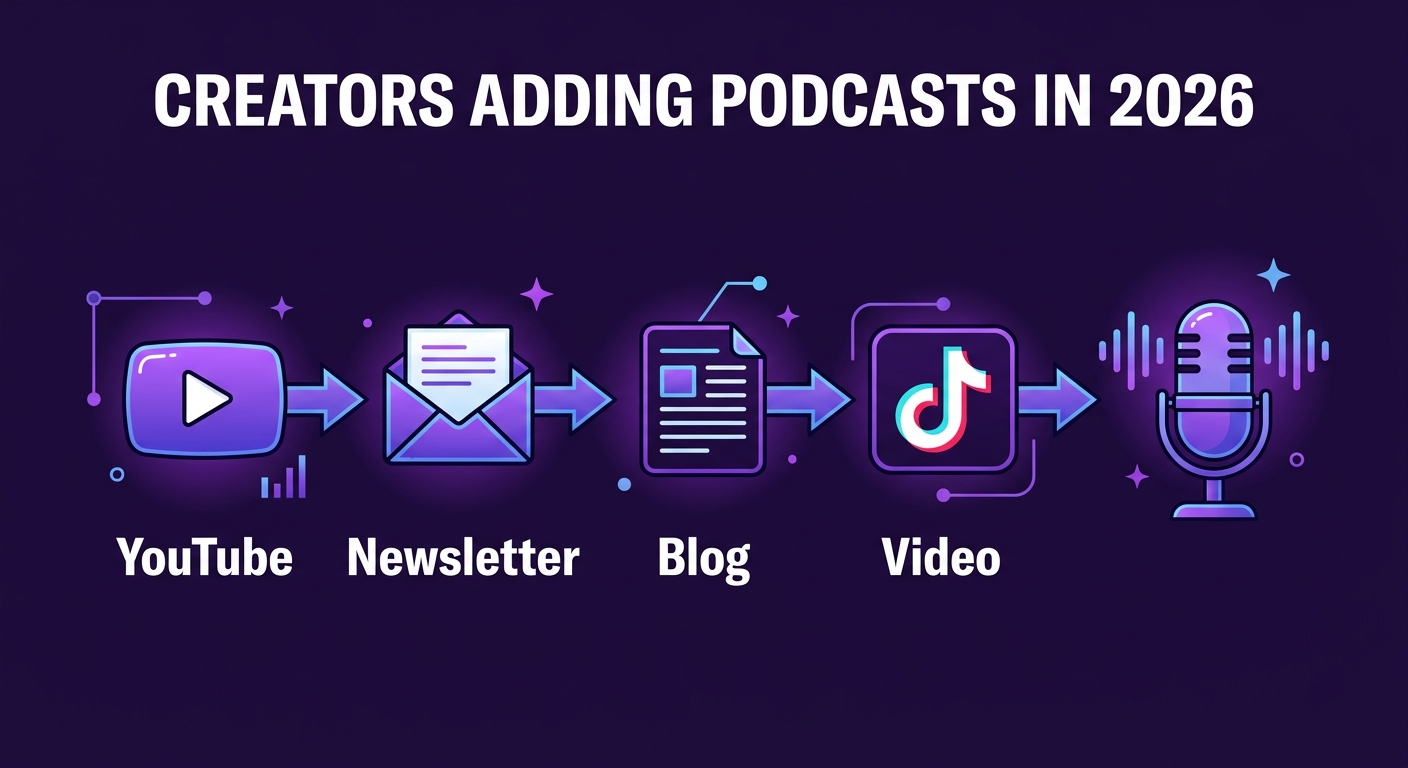
YouTube + Podcast: The Natural Crossover
YouTube's own data shows that 23% of YouTube watch time now happens on podcasts specifically — a category the platform actively promoted from 2023 onward. Creators who post their podcast to YouTube as a video (using AI-generated video formats) benefit from YouTube's algorithm serving the content to subscribers who prefer long-form audio, while also appearing in YouTube's dedicated podcast section.
The two-platform strategy works because the audiences behave differently. YouTube viewers watch actively — they're choosing to sit down and watch. Podcast listeners consume passively — commuting, cooking, exercising — and they're more likely to listen to the full episode and come back weekly. Building both audiences simultaneously is now possible with a single piece of AI-generated content.
Newsletter to Podcast: The Audio Edition Model
Newsletter creators have discovered that a significant portion of their subscriber list — estimates range from 25–40% — would engage more if they could listen rather than read. The "audio edition" model is simple: your weekly newsletter issue becomes a podcast episode published the same day. Subscribers who prefer listening get full coverage; readers who prefer text get the original. Open rates for hybrid newsletter/podcast creators consistently outperform text-only newsletters, because audio episodes drive subscribers back to the main newsletter and vice versa.
See our complete guide to turning a blog post into a podcast for the full workflow.
Blog to Podcast: SEO + Audio Discovery
Bloggers who convert their posts to podcast episodes get a compounding SEO and discovery benefit. The podcast episode creates a new backlink opportunity (show notes link back to the blog post), appears in Spotify and Apple Podcasts search results for the same keywords your blog targets, and generates a YouTube video that can rank independently. One piece of content becomes three separate discovery surfaces — each feeding traffic back to the others.
Why Audio Reaches Audiences Your Other Content Doesn't
Different audience segments have different media consumption habits that align with different life contexts. Understanding these contexts explains why audio consistently reaches buyers and fans that video and text miss:
| Context | Primary Medium | Why Audio Wins |
|---|---|---|
| Morning commute | Audio | Eyes-free, hands-free consumption |
| Exercise / gym | Audio | Screen use is impractical |
| Cooking / household tasks | Audio | Background consumption while doing tasks |
| Long drives | Audio | 3–4 hour listening sessions possible |
| Desk work (passive) | Audio | Background learning while working |
| Sitting down, focused | Video / Text | Active attention available |
"The average podcast listener spends 7 hours per week listening to podcasts. They're not replacing video or reading — they're filling time that was previously silent. Creators who aren't in audio are missing hours of weekly attention they can never recapture through other channels."
— Edison Research, The Infinite Dial 2025
This means your audience isn't choosing between your YouTube video and your podcast — they're consuming both in completely different contexts. A fan who watches your YouTube tutorial on their laptop might become a podcast listener who hears your episode while running every Thursday. The two formats reinforce each other rather than competing.
Monetization Options for Creator Podcasts
Sponsorships and Host-Read Ads
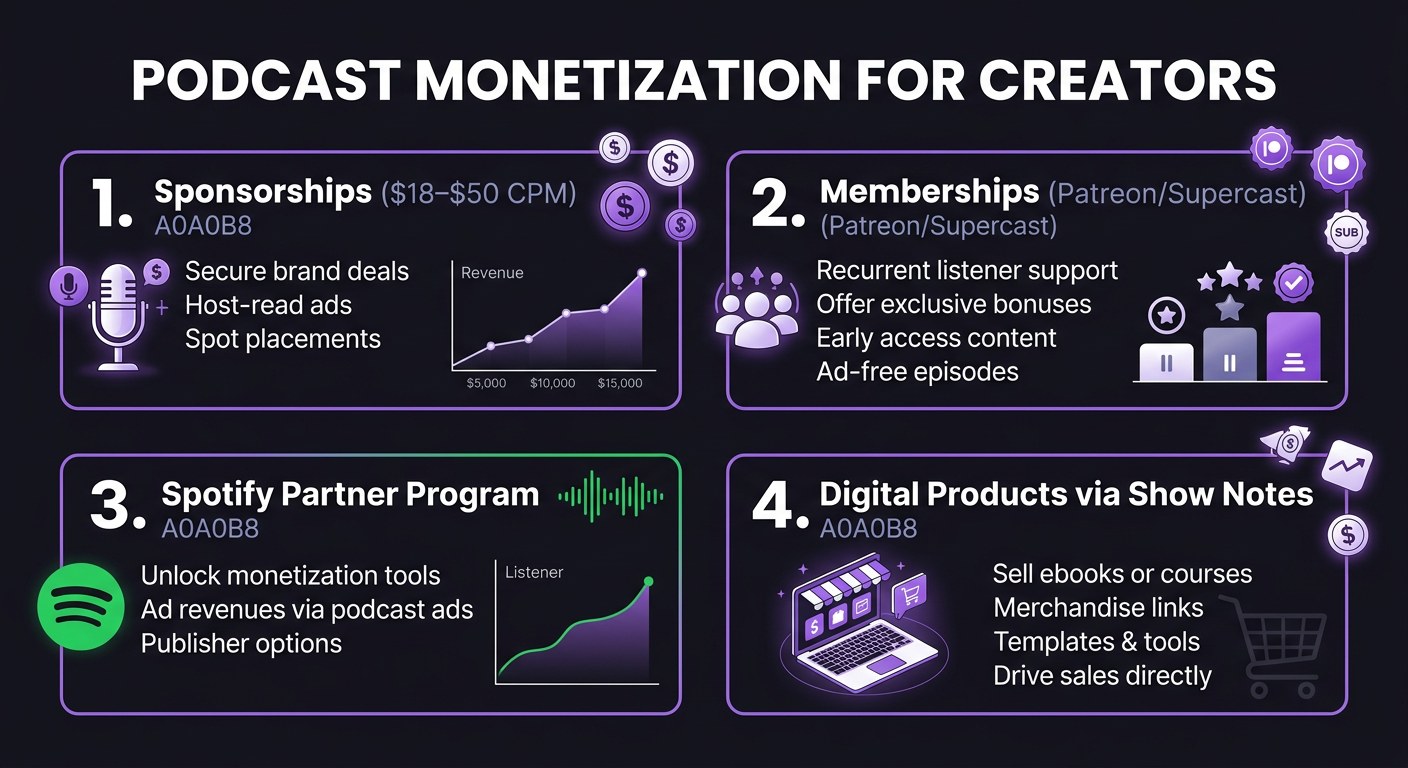
Podcast advertising rates have consistently outperformed other digital ad formats. The standard metric is CPM (cost per thousand listens). For creator podcasts with engaged audiences in a clear niche:
| Ad Format | Typical CPM Range | Notes |
|---|---|---|
| Pre-roll (60 seconds, start of episode) | $18–$25 | Highest skip rate |
| Mid-roll (90 seconds, mid-episode) | $25–$50 | Highest retention, best performance |
| Post-roll (60 seconds, end of episode) | $10–$18 | Lowest rates, loyal listener segment |
| Integrated/Native sponsorship | $50–$100+ | Woven into content, niche audiences |
A podcast with 1,000 downloads per episode earning a $30 mid-roll CPM generates $30 per episode in ad revenue. At 2 episodes per week, that's $240/month — before accounting for multi-sponsor deals or direct sponsorship premiums, which can be 2–3x the programmatic rate.
Memberships and Listener Support
Platforms like Supercast, Patreon, and Apple Podcasts Subscriptions let creators offer premium feeds with bonus episodes, ad-free listening, or early access. Membership conversion rates for podcast audiences typically run 1–3% of total listeners — and at $5–$10/month, even 50 paying members adds $250–$500 in recurring monthly revenue.
Spotify Partner Program
Spotify's Partner Program pays eligible creators a share of Premium subscriber revenue based on listener hours — similar to YouTube's monetization model. While payout rates are lower than direct sponsorships, it represents passive income from your existing episode library that compounds as you publish more content.
Digital Products and Show Notes Funnels
Podcast show notes are an underutilized conversion surface. A creator selling a course, template, or digital product can include a direct link in every episode's show notes — and because podcast listeners have just spent 20–40 minutes building trust and context, conversion rates can be significantly higher than cold social traffic. Many creators report that their podcast is their highest-converting traffic source for digital product sales despite not being their highest-traffic channel.
Workflow for Solo Creators
The biggest objection solo creators have to podcasting is time. Here's how AI production eliminates that bottleneck:
- Choose your source content: Pick a blog post, YouTube script, newsletter issue, or topic you want to cover.
- Input to PodGorilla: Paste the URL, upload the PDF, or enter the topic. The AI generates a full, structured episode script in your chosen style — interview, solo commentary, news briefing, or others from PodGorilla's 12+ podcast styles.
- Select your voice: Choose from 300+ AI voices or use voice cloning to replicate your own voice from 60 seconds of audio — so your podcast sounds like you, even when you didn't record it.
- Preview and edit: Review the generated script and audio. Make any edits directly in the editor.
- Export video: Generate 16:9 for YouTube, 9:16 for TikTok/Reels, and 1:1 for Instagram — all with animated waveforms, auto-captions, and your branding.
- Publish everywhere: One click distributes to Spotify, Apple Podcasts, YouTube, TikTok, LinkedIn, and Instagram simultaneously.
Total time investment per episode: 10–20 minutes, including review. Compare that to 3–5 hours for a traditional recorded podcast episode with editing.
Building a Consistent Publishing Schedule With AI
Consistency is the single most important factor in podcast growth. Listeners subscribe because they trust you'll show up — and they unsubscribe (or stop listening) when you go dark for two weeks. Traditional podcast production makes consistency hard for solo creators because recording requires energy, environment, and time that doesn't always align with your schedule.
AI podcast production removes almost all of the friction that causes inconsistency:
- No recording environment needed: You can generate an episode from a coffee shop, on a sick day, or in 15 minutes between meetings.
- Batch production: Generate 4 episodes on a Sunday and schedule them to publish weekly. Your listeners experience consistency even if your week is unpredictable.
- No performance anxiety: AI generation means you're not trying to get the "perfect take" — the AI delivers consistent quality every time.
- No editing backlog: The most common reason podcast creators quit is the editing backlog. With AI production, there's no raw audio to edit — the episode is ready when generation completes.
For a complete overview of the no-recording approach, see how to start a podcast without recording. And for a broader look at where the format is headed, the 2026 podcast statistics guide covers the market data every creator should know.
Frequently Asked Questions
Do I need any special equipment to start an AI podcast?
No. PodGorilla generates everything from text input — no microphone, audio interface, or recording space required. If you want to use voice cloning to replicate your own voice, you'll need 60 seconds of clean audio, which can be recorded on a smartphone in a quiet room. That's a one-time setup step, not an ongoing requirement.
Can I use my existing YouTube content as podcast input?
Yes. PodGorilla accepts YouTube URLs directly. Paste the URL to any of your YouTube videos and the AI extracts the content, structures it as a podcast episode, and generates a fresh audio version — great for repurposing your video library into a podcast back-catalog.
How many episodes should I publish per week as a new creator?
For new podcasts, 1 episode per week is the standard recommendation. Consistency matters more than frequency. Once you've established a release rhythm and your back-catalog has 10–20 episodes, consider increasing to 2 per week. With AI production, the bottleneck is scheduling and promotion — not production time.
Will my audience know the podcast is AI-generated?
Modern AI voice quality is very high — most listeners can't distinguish AI voices from human recordings without being told. Many creators are transparent about using AI production tools and find their audience responds positively, viewing it as efficient and innovative. The content quality (insights, depth, usefulness) matters far more to listeners than whether a human or AI spoke the words.
How does podcast revenue compare to YouTube AdSense?
Podcast CPMs ($18–$50 for mid-rolls) are significantly higher than YouTube AdSense rates ($2–$8 CPM for most niches). However, podcast audiences typically start smaller than established YouTube channels. The advantage is that podcast revenue compounds — listeners return weekly, listen in full, and convert at higher rates for direct offers and sponsorships.
Can I start a podcast from a newsletter or Substack?
Absolutely — and it's one of the highest-leverage moves a newsletter creator can make. Your newsletter issues are perfectly structured for podcast conversion: they're written to be read, not watched, which means they translate to audio naturally. PodGorilla can take any newsletter URL or pasted text and generate a podcast episode in your brand voice.