The business case for branded podcasting has never been clearer — or more accessible. Decision-makers listen to podcasts at twice the rate of the general population. B2B buyers who follow your podcast for 6–12 months are dramatically more likely to buy than cold leads reached through paid channels. And with AI podcast generation, the content production barrier that kept most businesses out of podcasting has effectively disappeared. This guide covers the full ROI picture, use cases by business type, and the cost comparison that makes AI production the obvious choice.
The Business Podcast ROI Case
Branded podcasting delivers returns across multiple dimensions simultaneously — SEO, brand awareness, lead generation, and sales enablement — in a way that few other content investments can match.
Brand Authority and Share of Voice
A consistent podcast presence positions your business as a category authority in a way that blog posts and social content cannot replicate. Audio creates intimacy: when a decision-maker listens to your 30-minute episode during their commute, they're spending focused, uninterrupted time with your brand's ideas. That level of engagement is simply unavailable through any other marketing format at scale.
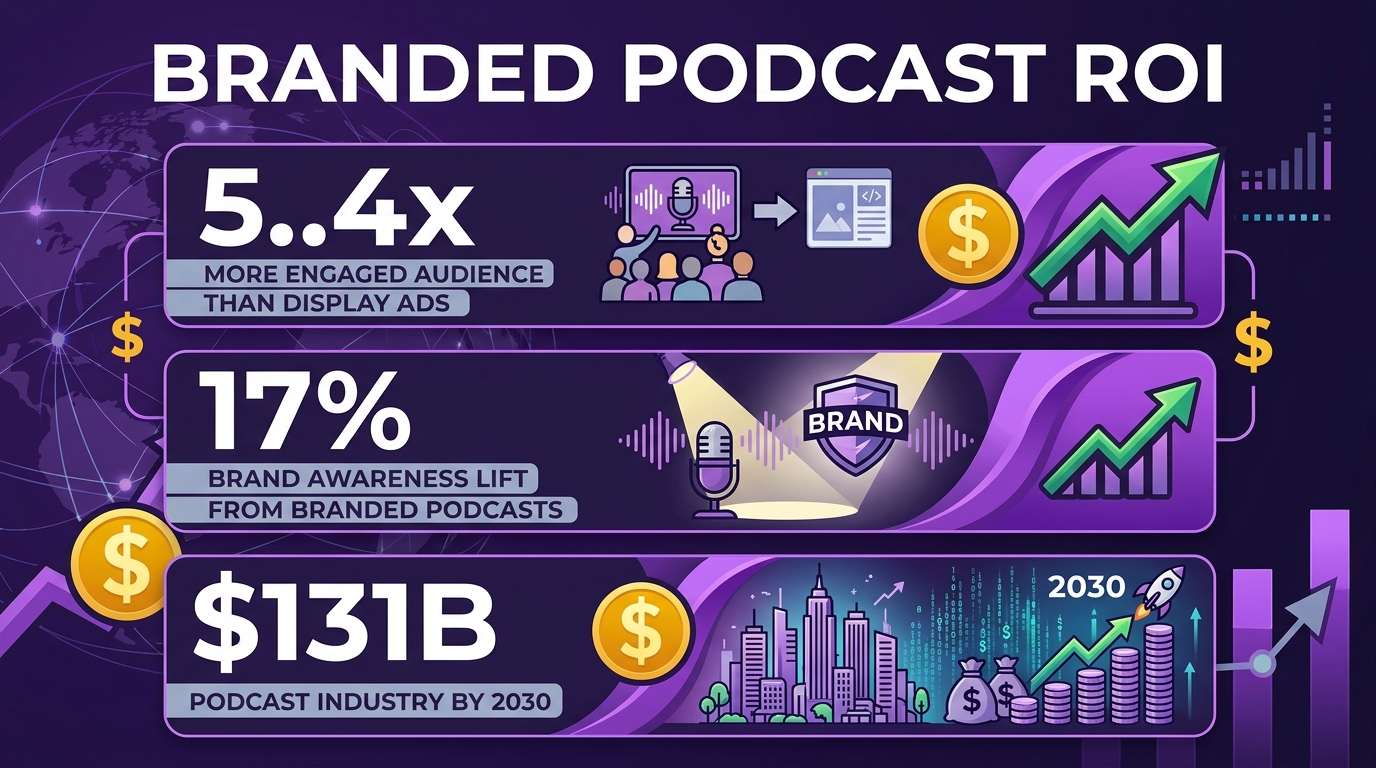
Research from Nielsen found that branded podcasts drive a 17% lift in brand awareness and that podcast listeners are 5.4 times more likely to engage with branded content compared to display advertising audiences. These numbers hold across B2B and B2C contexts.
SEO Impact
Each podcast episode creates multiple SEO assets: the episode page with transcript or show notes, the embedded audio player, and — when distributed to YouTube — a video asset that ranks independently. A business publishing 2 episodes per week generates 100+ new indexed pages per year, each targeting conversational long-tail queries that written blog posts often miss.
Podcast SEO also benefits from platform-specific search. Spotify and Apple Podcasts have their own search algorithms, and a business that appears in those results for relevant industry terms captures an entirely different discovery surface than Google alone provides.
Lead Generation and Pipeline Influence
| Business Podcast Metric | Benchmark | Source |
|---|---|---|
| B2B decision-makers who listen to podcasts weekly | 48% | Edison Research, 2025 |
| B2B buyers influenced by podcast in purchase decision | 38% | Demand Gen Report, 2025 |
| Branded podcast listener-to-lead conversion rate | 1–4% | Content Marketing Institute, 2024 |
| Sales cycle length reduction (podcast-nurtured leads) | 22–35% shorter | Salesforce State of Sales, 2025 |
| Average brand recall from podcast ads | 71% | Nielsen Audio, 2024 |
| Global podcast industry value (2025) | $30.8 billion | Grand View Research, 2025 |
| Projected podcast industry value (2030) | $131 billion | Grand View Research, 2025 |
"B2B buyers who consumed a vendor's podcast content were 35% more likely to request a demo within 90 days compared to buyers who only engaged with blog content. Audio creates a trust relationship that significantly accelerates the sales cycle."
— Demand Gen Report, B2B Content Consumption Study 2025
Use Cases by Business Type
SaaS Companies
SaaS businesses have some of the richest content libraries in any industry — product documentation, release notes, customer success stories, integrations guides, onboarding sequences — and most of it never gets consumed after it's written. AI podcasting turns this content into a consistent audio presence:
- Product update briefings: Monthly 5-minute episodes covering what's new in the product, framed for customers who prefer listening to reading release notes.
- Customer success story podcasts: Convert written case studies into interview-style audio narratives — more engaging than PDF case studies and shareable as standalone content.
- Category education series: Establish thought leadership by producing educational episodes on the broader problem your product solves, not just the product itself.
- Onboarding audio guides: New users who can listen to onboarding guidance while setting up the product retain information better and complete setup faster.
Agencies
Marketing, creative, and consulting agencies use branded podcasts to demonstrate expertise in a format that clients consume. An agency's podcast covering industry trends, client case study breakdowns, and tactical how-to episodes serves three functions simultaneously: it attracts new clients through SEO and podcast discovery, it nurtures existing client relationships by providing ongoing value, and it positions the agency's principals as thought leaders in the specific category where they want to win business.
Professional Services (Law, Finance, Accounting)
Professional services firms operate in heavily regulated industries where direct selling is often inappropriate or restricted. Podcasting provides a way to build trust and demonstrate expertise without pitching. A law firm's podcast covering regulatory changes, a financial advisor's weekly market commentary, or an accounting firm's tax strategy briefings all create ongoing touchpoints with potential clients in a format that builds credibility rather than generating objection.
Retail and E-Commerce
Retail brands use podcasts to build community and deepen customer relationships beyond the transaction. Product reviews, behind-the-scenes sourcing stories, founder interviews, and lifestyle content aligned with the brand's values create an audio identity that drives repeat purchases and loyalty in ways that promotional emails cannot.
Internal Business Podcast Use Cases
External marketing isn't the only application. Forward-thinking businesses are using AI podcasting internally to improve communication and training efficiency:
- Company all-hands summaries: Convert meeting notes and slides into audio briefings for employees who missed the live session or prefer audio review.
- Sales training content: Turn sales playbooks, objection-handling guides, and product knowledge documents into podcast episodes that sales reps can consume during commutes and travel.
- HR and onboarding briefings: New hire orientation materials, benefits explanations, and policy documents converted to audio for more engaging onboarding.
- Executive communications: Weekly or monthly leadership updates delivered as a podcast episode — more personal than an email, more scalable than a video call.
Cost Comparison: Traditional Agency vs AI Production
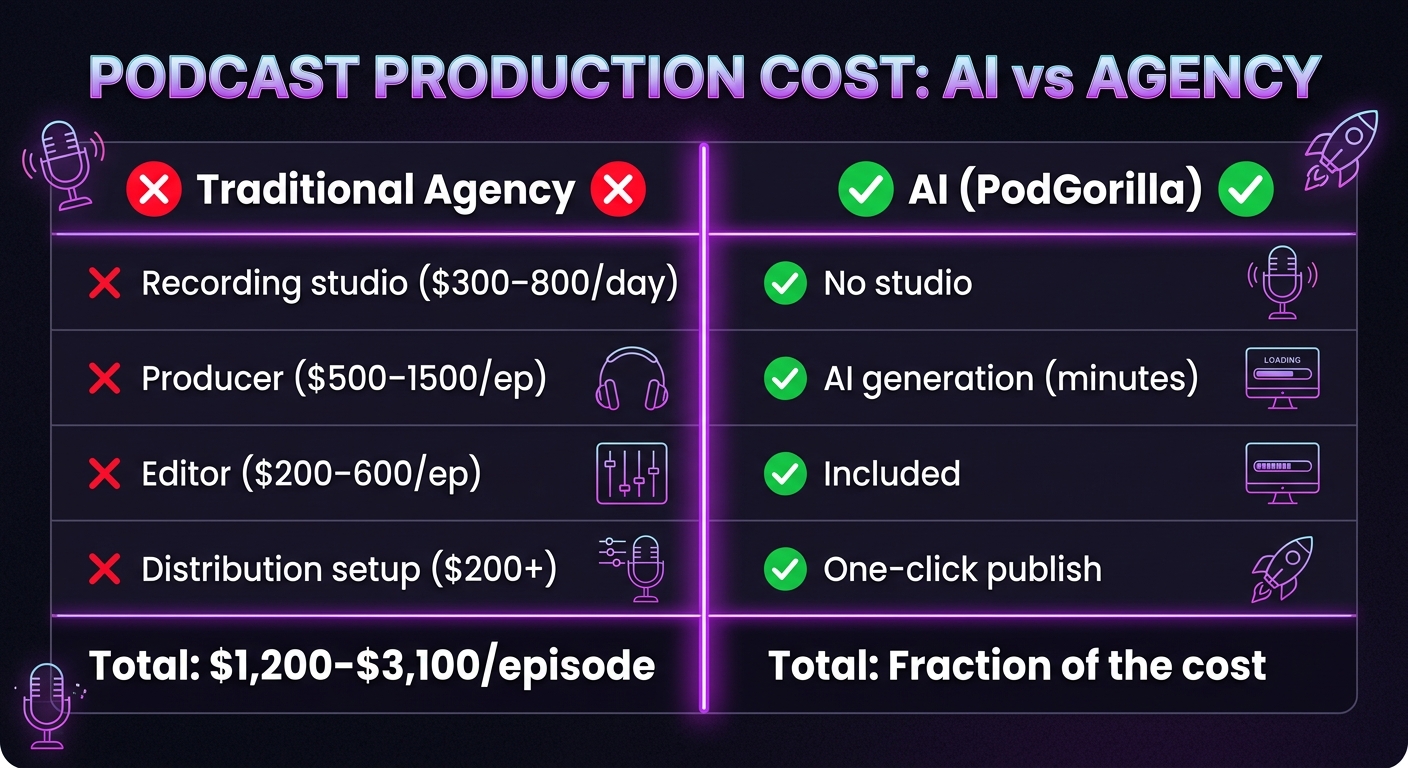
| Cost Component | Traditional Agency | PodGorilla AI |
|---|---|---|
| Recording studio / environment | $300–$800/day | Not required |
| Producer / scriptwriter | $500–$1,500/episode | AI-generated (included) |
| Audio editor | $200–$600/episode | Not required |
| Voice talent / host | $200–$1,000/episode | 300+ AI voices included |
| Distribution / hosting setup | $200+ setup + $20–50/mo | One-click, included |
| Video version (social clips) | $500–$2,000/episode | 16:9, 9:16, 1:1 included |
| Total per episode | $1,200–$3,100+ | Fraction of the cost |
| Production time | 1–2 weeks | Under 10 minutes |
At traditional production costs, a 2-episode-per-week publishing cadence would cost $125,000–$320,000 per year in production alone — before any distribution, promotion, or strategy costs. AI production fundamentally changes the ROI calculation and makes consistent podcast publishing accessible to businesses of any size.
White-Label AI Podcast Production
Agencies and marketing consultants are using AI podcast platforms to offer branded podcast production as a service to clients. The workflow is efficient: the agency manages the content strategy, topic selection, and client approval, while AI handles the actual production. The client receives a fully branded podcast series that would have cost $5,000–$15,000/month from a traditional podcast production agency — at a cost structure that allows the agency to price competitively while maintaining healthy margins.
For agencies building podcast production into their service offering, PodGorilla's features page covers the full capability set including voice cloning, video export formats, and multi-platform publishing.
Getting Started as a Business
The fastest path to a business podcast is starting with your existing content library. If you have 10 blog posts, you have 10 podcast episodes. If you have a case study bank, you have a season of your podcast already written. Connect them with a consistent episode structure — intro, topic, key takeaways, CTA — and you have a branded podcast series ready to launch.
Start with the PodGorilla $1 trial to generate your first episode from a blog URL or PDF. Have it published to Spotify, Apple Podcasts, and YouTube the same day. For a broader view of the podcast market your business is entering, the 2026 podcast statistics guide has the full picture. And if you're comparing production options before committing, the AI podcast tools comparison covers the landscape.
Frequently Asked Questions
How many episodes do we need before our business podcast shows results?
Most branded podcasts begin seeing meaningful organic discovery on Spotify and Apple Podcasts after publishing 8–12 episodes consistently. SEO benefits from episode pages begin appearing in search results within 4–8 weeks of launch. Lead attribution from podcast listeners typically becomes measurable in the 3–6 month range as your audience grows and begins converting through show notes CTAs and branded search.
What's the ideal episode length for a business podcast?
B2B decision-makers favor episodes in the 20–35 minute range — long enough to deliver genuine value and establish expertise, short enough to complete during a single commute. Short-form briefings (5–10 minutes) work well for product updates and news-style content. Long-form episodes (45–60 minutes) suit deep-dive thought leadership content if your audience is willing to invest the time.
Should our business podcast focus on our product or our industry?
Industry-focused content almost always outperforms product-focused content in audience growth and authority building. Buyers are searching for solutions to their problems, not for information about your product. A podcast that helps your target customer solve real problems in your category positions your business as a trusted advisor — and that relationship converts to sales far more reliably than a product-focused channel.
Can we use AI to clone our CEO's voice for the podcast?
Yes. PodGorilla's voice cloning feature creates a synthetic version of any voice from as little as 60 seconds of clean audio. This allows businesses to maintain a consistent, recognizable executive voice across all episodes without requiring the executive to record every episode — dramatically reducing the time burden on leadership while preserving the personal authority that an executive voice carries.
How do we measure whether our business podcast is generating leads?
Use UTM-tagged links in show notes to track traffic from specific episodes. Add "How did you hear about us?" to all demo and contact forms. Monitor branded search volume for spikes correlated with episode releases. Track LinkedIn engagement and connection requests for executives featured in episodes. For larger teams, dedicated podcast landing pages with form fills give the clearest attribution data.
Is it worth producing video versions of business podcast episodes?
Yes, especially for LinkedIn and YouTube. LinkedIn's algorithm strongly favors native video content, and a 2-minute audiogram clip from a podcast episode — with animated waveform and captions — consistently outperforms text posts and static images. PodGorilla exports video in 16:9, 9:16, and 1:1 formats with every episode, so the video version requires no additional production effort.