Why AI Movie Trailer Voices Are Revolutionizing Commercial Content in 2026
Remember the first time you heard "In a world..." and felt that visceral pull? That's the power of a killer movie trailer voice. It commands attention, builds anticipation, and sells millions in tickets.
Here's what most agencies don't realize: that same voice is now selling everything from SaaS products to real estate listings. And the talent that used to cost $5,000+ per session? You can deliver that exact cinematic punch for a fraction of the price—while pocketing margins that'll make your accountant smile.
AI movie trailer voice technology has blown the doors off what was once Hollywood's exclusive playground. The deep, authoritative tones that studios paid top dollar for are now accessible to anyone smart enough to position themselves as the gateway. We're talking about the same emotional resonance, the same commanding presence, minus the scheduling headaches and budget-crushing fees.
But here's where it gets interesting for you.
While your competitors are still offering basic voiceover services at commodity prices, you could be delivering premium cinematic voiceovers that clients didn't even know were possible—at price points that make you the obvious choice. Every business video, every product launch, every brand story is now an opportunity to inject that Hollywood magic your clients crave but thought they couldn't afford.
This isn't about replacing traditional voiceover artists. It's about capturing a market that was previously out of reach for 99% of businesses. The local law firm wanting gravitas in their commercials. The tech startup needing that epic product launch video. The real estate developer selling luxury properties. They all want that theatrical impact.
In this guide, you'll learn exactly how to position, price, and profit from AI movie trailer voices. You'll discover the specific use cases that command premium fees, the delivery methods that save you hours, and the positioning strategies that make clients choose you over everyone else.
The opportunity window is open. But not for long.
What Makes a Movie Trailer Voice Unforgettable (And Worth Paying For)
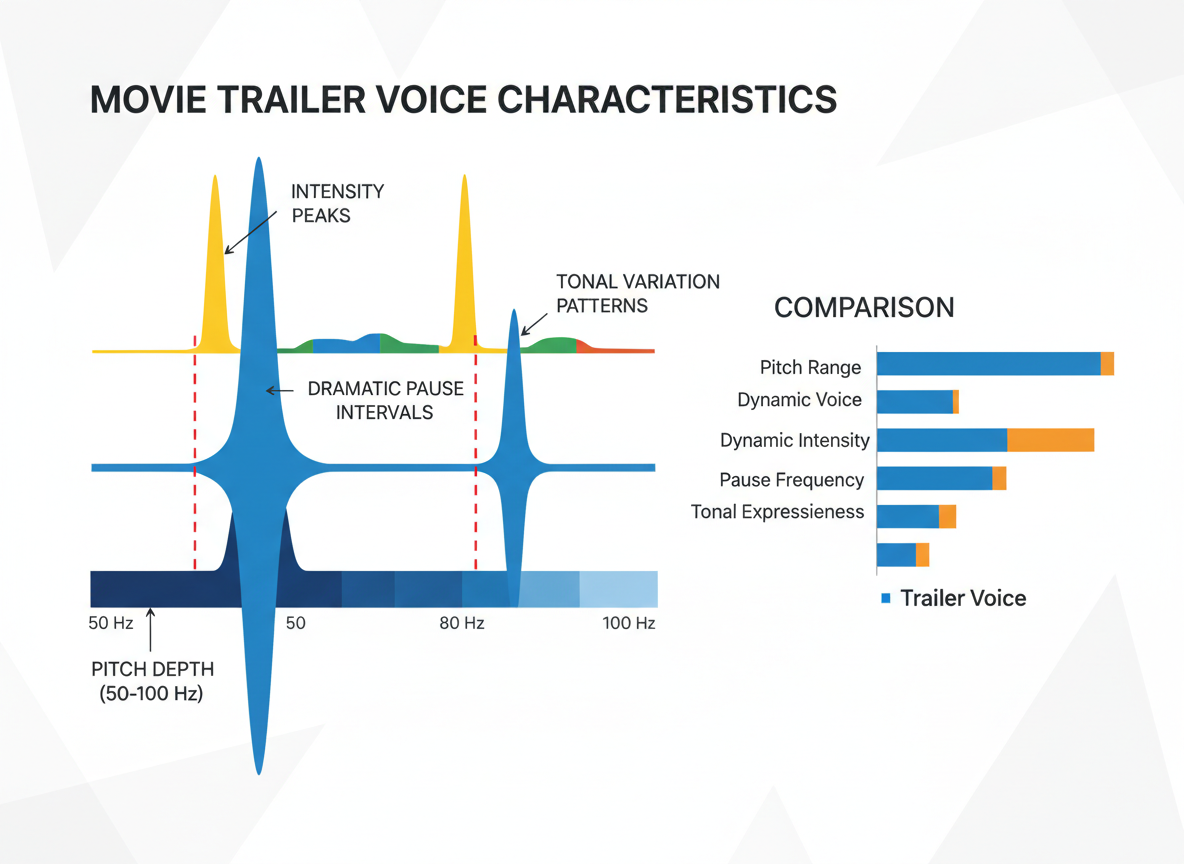
There's a reason studios shell out thousands for a single trailer voiceover. The difference between a forgettable promo and one that makes viewers hit "buy tickets now" comes down to three vocal parameters: resonance, pacing, and intensity control.
Deep resonance isn't just about having a bass-heavy voice. It's about creating frequencies that register in your chest cavity—literally making viewers feel the voice before their brain processes the words. That's why the classic trailer voice sits between 85-110 Hz, a frequency range that triggers primal attention responses. Your amygdala can't help but pay attention.
But here's where most people get it wrong. They think they need the deepest voice possible. That's outdated. What actually separates amateur trailer reads from professional ones is dynamic range control. Listen to a modern cinematic voiceover and you'll notice they're constantly modulating—whispering one moment, then building to a crescendo that punches through theater speakers. That contrast keeps your nervous system engaged.
The psychology is straightforward. Trailer voices exploit the same brain mechanisms that kept our ancestors alive. Low-frequency voices signal dominance and importance. Dramatic pauses create anticipation by triggering your brain's prediction circuits. Sudden intensity shifts spike cortisol just enough to make you alert without feeling threatened. It's audio manipulation at its finest.
Compare the legendary "In a world..." style to today's approach. That old-school style relied on sustained gravitas—every word dripping with theatrical weight. Modern trailer voices use what I call "conversational urgency." They sound like they're letting you in on a secret, building intimacy before hitting you with intensity. Think less opera, more confessional thriller.
Here's what clients are actually purchasing when they hire premium trailer voice talent: emotional manipulation expertise. They're not buying a voice—they're buying someone who knows exactly when to breathe, where to place emphasis, how to make "March 15th" sound like the most important date in human history.
With AI movie trailer voice technology advancing rapidly, those same psychological triggers can now be programmed and replicated. But understanding why they work? That's still the domain of professionals who've spent years studying what makes audiences lean forward in their seats. The technology's getting there. The question is whether you'll be positioned to profit from it when everyone else catches on.
The 5 Movie Trailer Voice Styles Every Agency Must Master
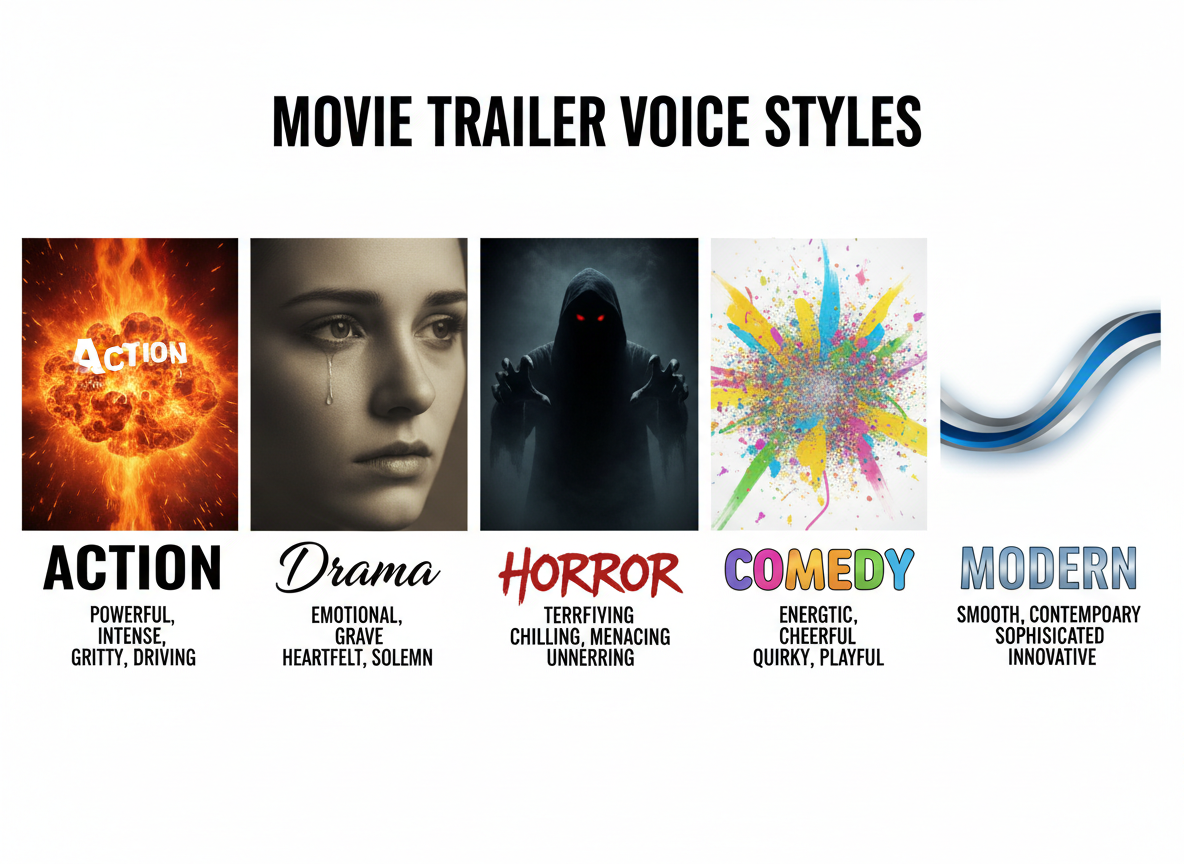
Here's what separates agencies charging $500 per project from those commanding $5,000+: they've mastered the five core ai movie trailer voice styles that Hollywood studios have been using for decades.
Most agencies fumble around with generic "professional" voices. They're leaving serious money on the table. Each trailer style connects with specific emotions, and when you nail the match between style and content, clients recognize the difference immediately.
Epic Action Voice: Deep, Commanding, Explosive Energy
This is the voice that sells blockbusters. Think deep chest resonance, deliberate pacing, and words that hit like percussion. The Epic Action voice doesn't ask for attention—it demands it.
Your AI voiceover needs to drop into a lower register with controlled power. Words like "unleash," "destiny," and "rise" should feel weighted. Use strategic pauses before impact words. This style works for action films, thriller content, sports brands, and any campaign built around competition or transformation.
Real-world application: A fitness brand launching a challenge program needs this energy. So does a cybersecurity company positioning their product as protection against digital threats. The Epic Action voice says, "Something big is happening, and you need to pay attention."
Dramatic Narrator: Emotional Storytelling Voice
The Dramatic Narrator pulls viewers into personal journeys. It's warmer than Epic Action but carries emotional depth. This voice rises and falls with the story's arc, creating intimacy even while projecting authority.
Here's where your ai movie trailer voice needs nuance. You're not just reading words—you're telling someone's story. The pacing slows down for reflective moments, then builds during pivotal scenes. This style dominates biopics, dramas, documentaries, and any content centered on human transformation.
Use this for: Nonprofit campaigns, personal development programs, financial planning services, healthcare testimonials. Anywhere the narrative centers on change, struggle, or achievement. The voice should feel like a trusted guide walking alongside the audience.
Horror/Suspense Voice: Ominous, Whisper-to-Roar Dynamics
The Horror voice lives in contrast. It starts quiet—almost intimate—then explodes into intensity. This whisper-to-roar dynamic creates tension better than any visual effect.
Your AI system needs to handle extreme range here. Quiet passages should feel unsettling, not weak. The buildup matters more than the peak. This isn't just for horror films. Mystery podcasts, true crime content, psychological thriller novels, and even cybersecurity awareness campaigns benefit from this approach.
The key: restraint amplifies impact. Don't go big too early.
Comedy Trailer Voice: Self-Aware, Playful Delivery
Comedy trailers broke free from traditional voice styles years ago. The Comedy voice knows it's a voice—it plays with expectations, timing, and irony. This requires precision that most agencies underestimate.
Timing matters more here than any other style. A half-second pause before the punchline changes everything. This voice works for comedy content, irreverent brands, parody campaigns, and any marketing that positions itself as the anti-corporate alternative.
Strategic fit: DTC brands targeting younger audiences, entertainment content, apps with personality, or any service that differentiates through humor.
Modern Minimalist: Conversational Yet Powerful
The newest style flips everything. It's understated but confident. No theatrical delivery—just straight talk with enough presence to hold attention.
This ai movie trailer voice feels like a recommendation from someone who knows their stuff. It's conversational without being casual, authoritative without being pompous. Tech companies, SaaS products, modern lifestyle brands, and forward-thinking agencies themselves use this approach.
The Modern Minimalist says, "I don't need to yell to get your attention—what I'm offering speaks for itself."
Master these five styles, and you'll match the right voice to every client brief. That's when pricing conversations shift entirely.
How AI Movie Trailer Voices Actually Work (The Technology Behind the Drama)
Here's what most people don't realize about ai movie trailer voice technology: it's not just recording a voice and playing it back with different words. The systems powering today's cinematic voiceovers use neural networks that actually understand the acoustic patterns of human speech at a molecular level.
Think of it this way. When you feed an AI model thousands of hours of trailer narration—capturing every breath, inflection, and dramatic pause—the neural network doesn't memorize phrases. Instead, it learns the mathematical relationships between phonemes, pitch variations, and emotional intensity. It's breaking down what makes that gravelly "In a world..." voice work on a fundamental level.
The training process maps vocal characteristics across multiple dimensions: tone, timbre, cadence, resonance, and emotional coloring. Modern models analyze spectrograms (visual representations of sound frequencies) and learn how professional voice actors shift between chest voice and head voice, where they place emphasis, and how they manipulate timing for maximum impact.
Voice cloning takes this further. You can feed the system a 10-minute reference sample of any voice—whether that's your own or a professional narrator's—and the AI reverse-engineers that vocal signature. The customization parameters let you adjust everything from speaking pace to emotional intensity. Want more gravitas? Increase the lower frequency resonance. Need urgency? Tighten the pacing and sharpen the consonants.
Here's where quality becomes obvious. Basic AI voices use simpler models with limited training data, producing that slightly robotic, flat delivery you've probably heard in cheap text-to-speech tools. Premium models—the ones studios are quietly using right now—train on studio-quality recordings with professional direction. They've ingested thousands of hours of expert performances, learning not just how words sound, but how emotion translates into acoustic energy.
The result? Modern ai movie trailer voice technology produces performances indistinguishable from human talent because it's learned from the best human performances ever recorded. When you're listening to that perfectly-timed dramatic reveal in a 2026 trailer, you genuinely can't tell anymore. The technology has crossed the uncanny valley and kept running.
Step-by-Step: Creating Professional Movie Trailer Voiceovers With AI
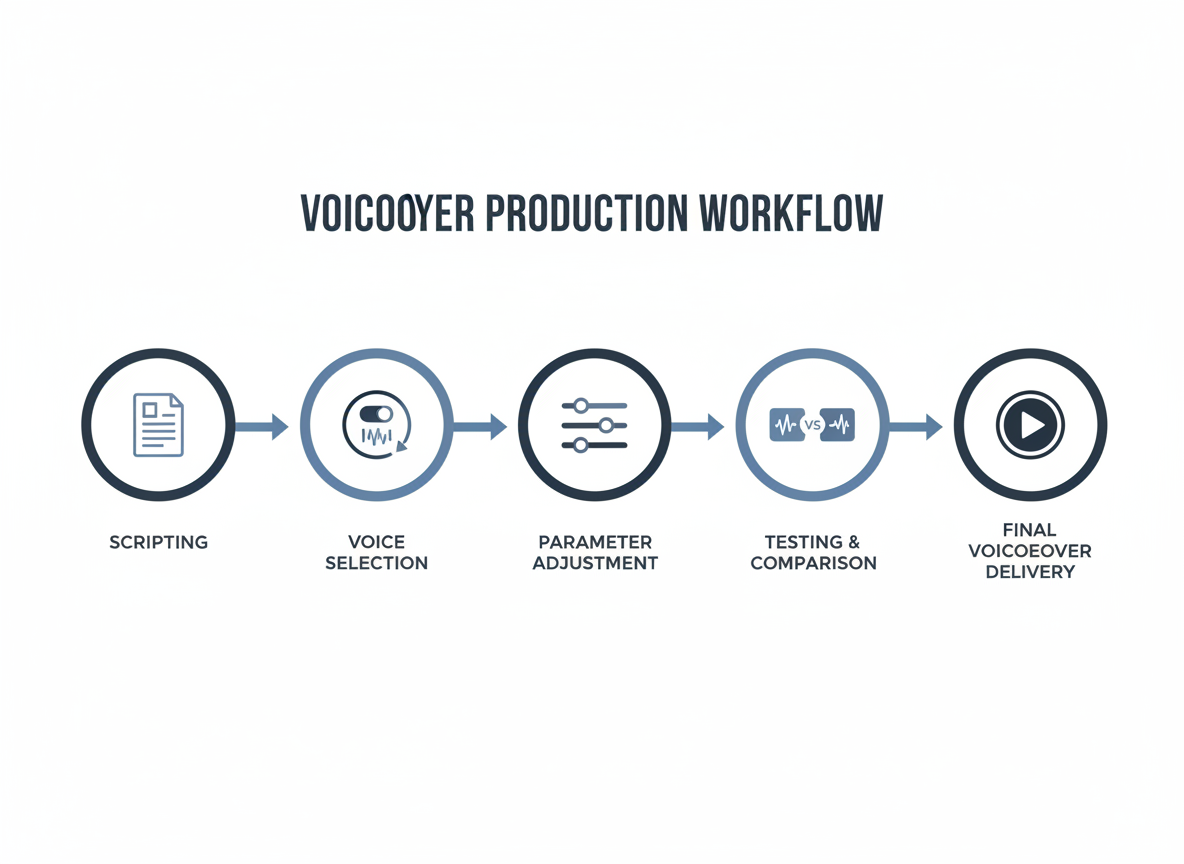
You've got the script. You've got the AI movie trailer voice tools. Now it's time to create something that makes viewers stop scrolling and actually watch. Here's exactly how to do it.
Step 1: Script Preparation and Pacing Markup
Before you touch any AI tool, mark up your script like a conductor preparing a symphony. Identify where you need dramatic pauses—those heart-stopping moments between "In a world..." and what comes next. Underline words that need emphasis. Mark your cadence changes where the pacing shifts from slow burn to rapid-fire intensity.
Here's what this looks like in practice: "In a world//...where hope is lost/...ONE MAN//stands between chaos/and annihilation." The slashes indicate pause lengths, and caps signal emphasis. This markup becomes your blueprint.
Step 2: Voice Selection by Genre
Your thriller needs Don LaFontaine gravitas. Your rom-com? Something warmer, maybe slightly self-aware. Action films demand authoritative power with aggressive undertones. Horror works best with whispered menace that builds to thunderous warnings.
Test three different voice profiles before committing. What sounds perfect in your head might fall flat when rendered. Trust your ears, not your assumptions.
Step 3: Parameter Adjustment
This is where beginners waste hours and pros save days. Start with pitch—drop it for authority, raise it slightly for urgency. Speed controls tension: slower for dread, faster for action sequences. Emphasis markers tell the AI where to punch specific words.
The magic's in the pauses. A half-second pause before a reveal? That's tension. A full-second pause? That's anticipation. Master this, and you're already ahead of 90% of people fumbling with AI movie trailer voice generation.
Step 4: Generation and A/B Testing
Generate at least three versions with slight variations. Maybe version A has deeper bass resonance, version B pushes harder on emotional beats, and version C experiments with unconventional timing. Play them back-to-back. The winner usually reveals itself immediately.
Step 5: Audio Enhancement and Delivery
Raw AI output isn't delivery-ready. Add subtle reverb for cinematic depth. Layer a slight EQ boost in the low-mids for theatrical warmth. Compress dynamics so whispers stay audible and shouts don't blow out speakers. Export at 48kHz/24-bit for professional standards.
Pro Tips That Separate Amateurs from Pros
Start with a reference trailer you admire. Match its energy curve, not its exact delivery. Build a swipe file of timing patterns that work. And here's the truth most won't tell you: the first take's rarely the best. Generate multiple versions, step away for an hour, then choose with fresh ears. That's when you'll spot what actually commands attention versus what just sounds impressive in the moment.
Genre-Specific Voice Selection: Matching Voice to Message
Your AI movie trailer voice needs to fit the genre, or it'll fall flat—no matter how good the technology is. Here's how to match voice characteristics to specific trailer types.
Action/Thriller: Raw Power and Urgency
Action trailers demand gravelly, intense vocals with aggressive pacing. Think deep chest resonance with sharp consonants that punch through the mix. Your AI voice should accelerate during action sequences and drop to a near-whisper for tension builds.
Sample script: "They took everything. Now he's taking it back."
Choose an AI voice with strong low-end frequency response and the ability to bite hard on words like "took" and "back." Energy level stays at 8-10 throughout, with strategic pauses that feel like coiled springs ready to release.
Drama/Romance: Warmth and Emotional Resonance
These trailers need conversational intimacy, not bombast. Select AI voices with mid-range warmth and natural breath patterns. The cadence should flow like you're sharing a secret, not announcing the apocalypse.
Sample script: "Sometimes love isn't about finding the right person. It's about becoming someone worth finding."
Look for softer onset on vowels and the ability to convey vulnerability. Pacing slows down—give the words room to breathe and land emotionally.
Horror/Suspense: Atmospheric Dread
Horror trailers thrive on whispered menace and unsettling calm. Your AI voice should possess exceptional dynamic range—capable of shifting from barely audible murmurs to sudden intensity. Avoid constant shouting; sustained low-volume delivery creates more unease than volume ever will.
Sample script: "It knows you're afraid. And it's hungry."
Choose voices that can sustain an eerie, controlled tone with slight distortion capabilities for maximum creep factor.
Comedy: Self-Aware Timing
Comedy trailers need perfect timing and knowing inflection. The AI voice should sound slightly amused by its own seriousness—like it's in on the joke. Upward inflections on unexpected words and strategic pauses before punchlines matter here.
Sample script: "This summer... one man will discover that saving the world (pause) is easier than planning a wedding."
Documentary/Corporate: Credible Authority
These demand steady, measured delivery with clear articulation. Select AI voices that sound educated without being condescending. The pacing should be deliberate, allowing viewers to absorb information while maintaining forward momentum.
The right voice-genre match transforms your trailer from background noise into something viewers actually remember.
Commercial Use Cases: Where Movie Trailer Voices Print Money
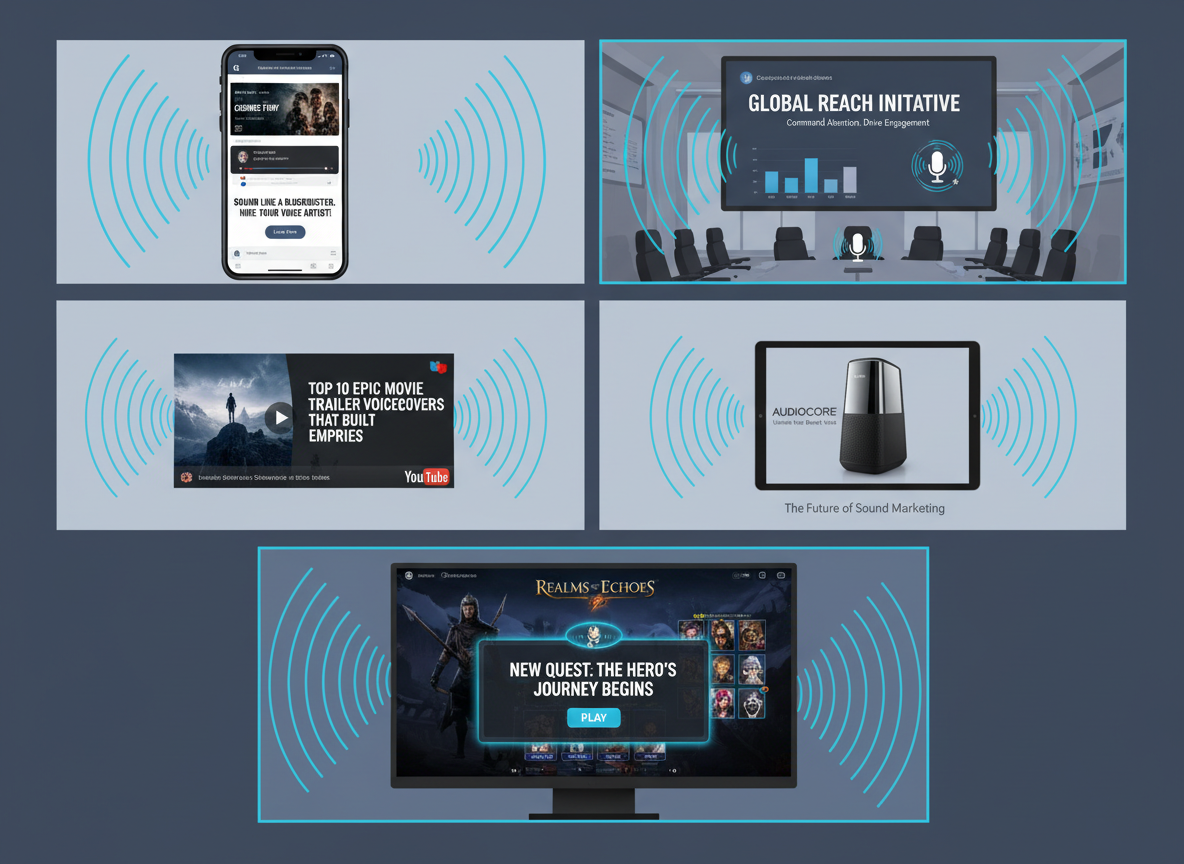
The real gold mine isn't Hollywood. It's everywhere else.
While traditional production houses charge five figures for custom voiceovers, you're sitting on a technology that delivers the same cinematic punch in minutes. Here's where the ai movie trailer voice becomes a cash-printing machine for your agency.
Product launches are the heavyweight champion of trailer voice applications. Tech companies launching new software? They need that epic reveal energy. Consumer brands dropping new product lines? They're hungry for voiceovers that make a water bottle feel like the next iPhone. You're looking at $2,500-$8,000 per project, with most takes less than four hours to produce. Your margin? Somewhere between 70-90% once you factor in software costs.
Social media ads might seem small-time, but volume tells a different story. E-commerce brands burn through dozens of ad variations monthly. A single client needs trailer-style hooks for TikTok, Instagram Reels, and YouTube pre-rolls. Charge $500-$1,200 per ad package, deliver five variations, and suddenly you're stacking $6,000 monthly retainers from clients who previously couldn't afford professional voice talent.
Corporate sizzle reels are where executive egos meet marketing budgets. Companies pitching investors or showcasing achievements at conferences will pay premium rates for that gravitas. Think $3,500-$12,000 per video. They're not buying voiceovers—they're buying perceived credibility and authority.
YouTube creators and podcasters represent the long-tail opportunity. Channel intros, podcast trailers, and content bumpers might only command $300-$800 each, but these clients multiply fast. They refer friends. They need updates. They launch new shows. One client becomes five within six months.
Event promotion spikes seasonally but pays exceptionally well. Conference organizers, concert promoters, and festival marketers need that "THIS IS THE EVENT OF THE YEAR" energy. Budget range: $1,500-$5,000 per campaign, usually requiring multiple deliverables.
Video game trailers and entertainment content bridge into the industry that invented this whole aesthetic. Indie game developers can't afford union voice actors, but they'll stretch budgets for AI-powered cinematic quality. You're competing on turnaround time and price flexibility, typically landing $2,000-$6,000 per project.
The pattern? Every business wants to sound bigger than they are. Your ai movie trailer voice capability makes that transformation possible—and profitable. The question isn't whether demand exists. It's whether you're positioned to capture it before everyone else figures this out.
Advanced Voice Customization: Fine-Tuning for Maximum Impact
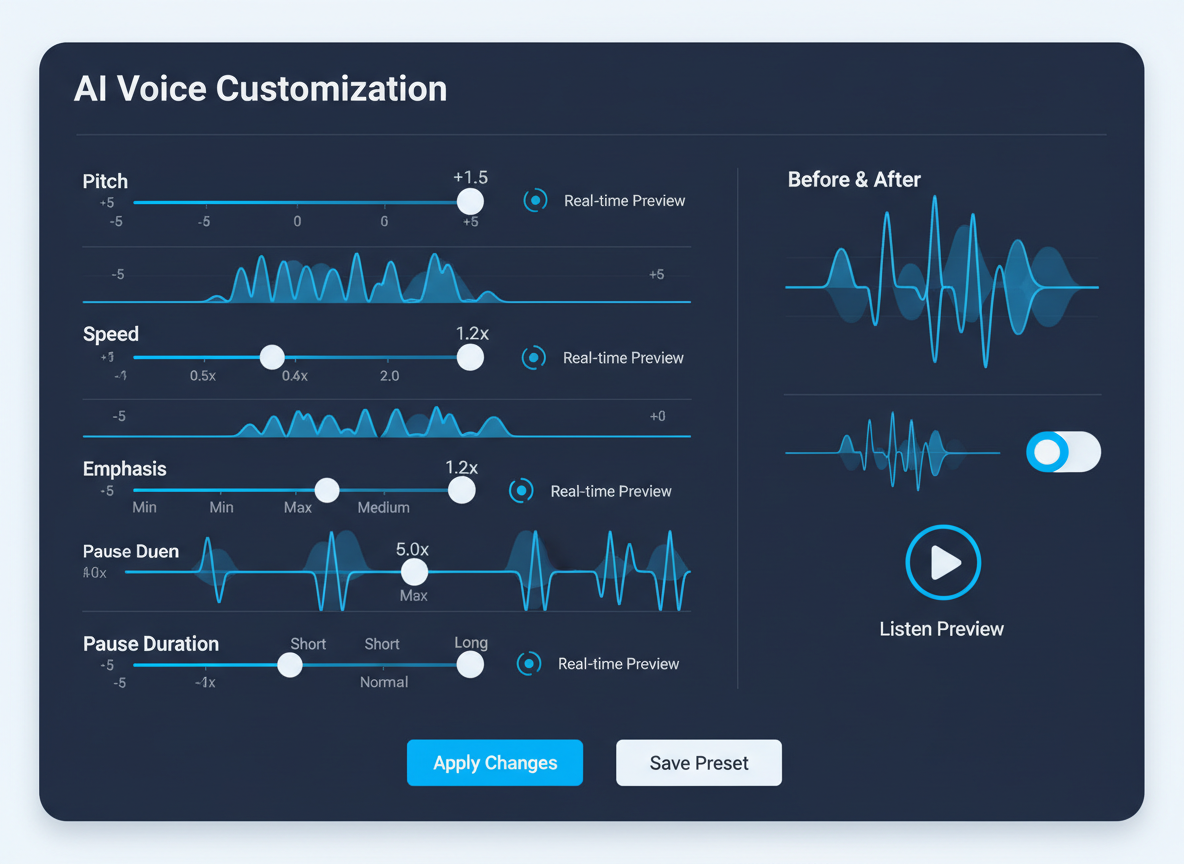
Here's where most people fumble with AI movie trailer voice generation—they accept the default settings and wonder why their trailers sound flat. The difference between amateur and professional results lives in these micro-adjustments.
Pitch control transforms your trailer's emotional weight. Drop the pitch by 15-20% (typically -2 to -4 semitones) when you want that authoritative, epic feel for action or thriller content. Think superhero origins or apocalyptic scenarios. But don't automatically assume deeper equals better. Lighter pitches (+1 to +2 semitones) work beautifully for comedy trailers, romantic films, or anything targeting younger audiences. The sweet spot for drama? Stick closer to neutral with subtle -1 semitone adjustments.
Speed variation separates the amateurs from the pros. Your baseline should hover around 0.9x to 1.0x normal speed for dramatic builds. When tension mounts, slow down to 0.75x-0.85x speed on key phrases. "He thought he knew the truth" delivered at 0.8x speed hits different than rushing through it. Then spike the tempo to 1.1x-1.3x for action sequences or rapid-fire reveals. This creates sonic whiplash that keeps audiences locked in.
Emphasis placement directs where listeners focus their attention. Modern AI tools let you boost specific words by 20-40% in volume or intensity. In the line "Nothing will ever be the same," emphasize "nothing" and "same"—not every word. Over-emphasis kills impact. Choose two to three words per sentence maximum.
Pause engineering might be your most powerful weapon, yet it's criminally underused. Insert 0.5-second pauses before major reveals. Extend to 0.8-1.2 seconds after shocking statements to let them breathe. The silence before "Until now..." can carry more weight than the words themselves. Strategic pauses at 60-70% through your trailer reset audience attention for the final push.
Tone layering adds the complexity that separates good from unforgettable. Blend your primary delivery with subtle undertones—add a 10-15% whisper effect for conspiracy thrillers, layer in slight distortion (5-8%) for horror, or introduce warmth parameters (+20-30%) for heartfelt drama. These micro-adjustments create depth without overwhelming the primary message.
The agencies charging $5,000+ per trailer? They're manipulating these exact parameters. Now you've got the blueprint.
Classic vs. Modern: The Evolution of Movie Trailer Voice Styles
Remember Don LaFontaine? His legendary "In a world..." became the soundtrack of an entire generation's movie-going experience. That deep, authoritative rumble didn't just announce films—it commanded audiences into theaters. LaFontaine recorded over 5,000 trailers during his career, creating what we now recognize as the golden age of trailer voiceovers.
That classic style had unmistakable characteristics: dramatic pauses, intense gravitas, and a larger-than-life presence that positioned the narrator as an omniscient storyteller. It worked brilliantly for action blockbusters, thrillers, and epic dramas. The voice wasn't part of the story—it was above it, delivering proclamations from on high.
Then everything changed.
The industry shifted dramatically in the mid-2000s because audiences evolved. People grew tired of being told what to think. The old announcer style started feeling manipulative, overly dramatic, even satirical. Comedies began mocking the traditional trailer voice, which signaled its decline faster than any focus group ever could.
Modern cinematic voices brought something completely different: conversational power wrapped in authentic intensity. Think intimate, genuine, sometimes even vulnerable. Today's top trailer voices sound like they're part of the story, not above it. They invite rather than command. They whisper secrets instead of shouting pronouncements.
Here's where AI movie trailer voice technology becomes your strategic weapon.
Unlike human voice actors who typically excel in one style or the other, AI models can master both approaches. Need that classic theatrical boom for a period piece or nostalgic project? You've got it. Want that contemporary, emotionally resonant style for a documentary or indie drama? Done. The same AI voice can pivot between styles depending on your client's needs.
Your strategic decision comes down to audience expectations and brand positioning. Classic works when you're aiming for nostalgia, parody, or specific genre conventions. Modern styles dominate when authenticity matters—which is most of the time now.
Smart agencies aren't choosing one style forever. They're matching voice style to project goals, and AI finally makes that flexibility profitable. You're not hiring different voice actors for different styles. You're selecting the right approach within seconds, testing variations, and delivering exactly what converts for each unique client.
Legal and Licensing: Commercial Rights You Must Understand
Here's where most agencies get blindsided: they deliver a killer AI movie trailer voice for a client's campaign, it performs brilliantly, then lawyers start sending letters about unauthorized voice usage. You don't want to be there.
Commercial licensing for AI-generated voices isn't optional—it's your insurance policy against disaster. When you're creating trailer content for paying clients, you need explicit commercial rights. Those free AI voice tools? They're ticking time bombs. Most restrict commercial use entirely or bury limitations in their terms that'll void your client contracts.
Voice cloning creates even trickier territory. You can't just clone Morgan Freeman's voice because it sounds perfect for your luxury car trailer. Celebrity voices require explicit permission, paid licensing agreements, and often residual fees. Even non-celebrity voices need documented consent if you're cloning someone specific. The legal precedents around voice rights are expanding rapidly, and courts are siding with voice owners.
Platform restrictions vary wildly. YouTube's Content ID system flags unlicensed audio automatically. Broadcast networks require proof of commercial rights before airing anything. TikTok and Instagram have their own content policies that'll shut down campaigns using unauthorized voices. Your client's six-figure ad spend vanishes if their content gets pulled for rights violations.
Smart agencies protect themselves with ironclad agreements. Your client contracts should specify that all AI-generated voices carry full commercial licenses. Document the voice platform you're using, screenshot the licensing terms, and include usage scope details—broadcast, digital, duration, geographic territories. This isn't paranoia; it's professional liability protection.
Premium AI voice platforms charge more because they've handled the legal heavy lifting. They've secured commercial licenses, built usage tracking systems, and provide documentation you can show clients (and their lawyers). That $200/month difference between a hobby platform and professional-grade service? It's nothing compared to a $50,000 lawsuit settlement.
The agencies winning big with AI movie trailer voice services understand this: cutting corners on licensing costs infinitely more than paying for proper rights upfront. Your reputation and business viability depend on getting this right from day one.
Real Results: Case Studies and Performance Benchmarks
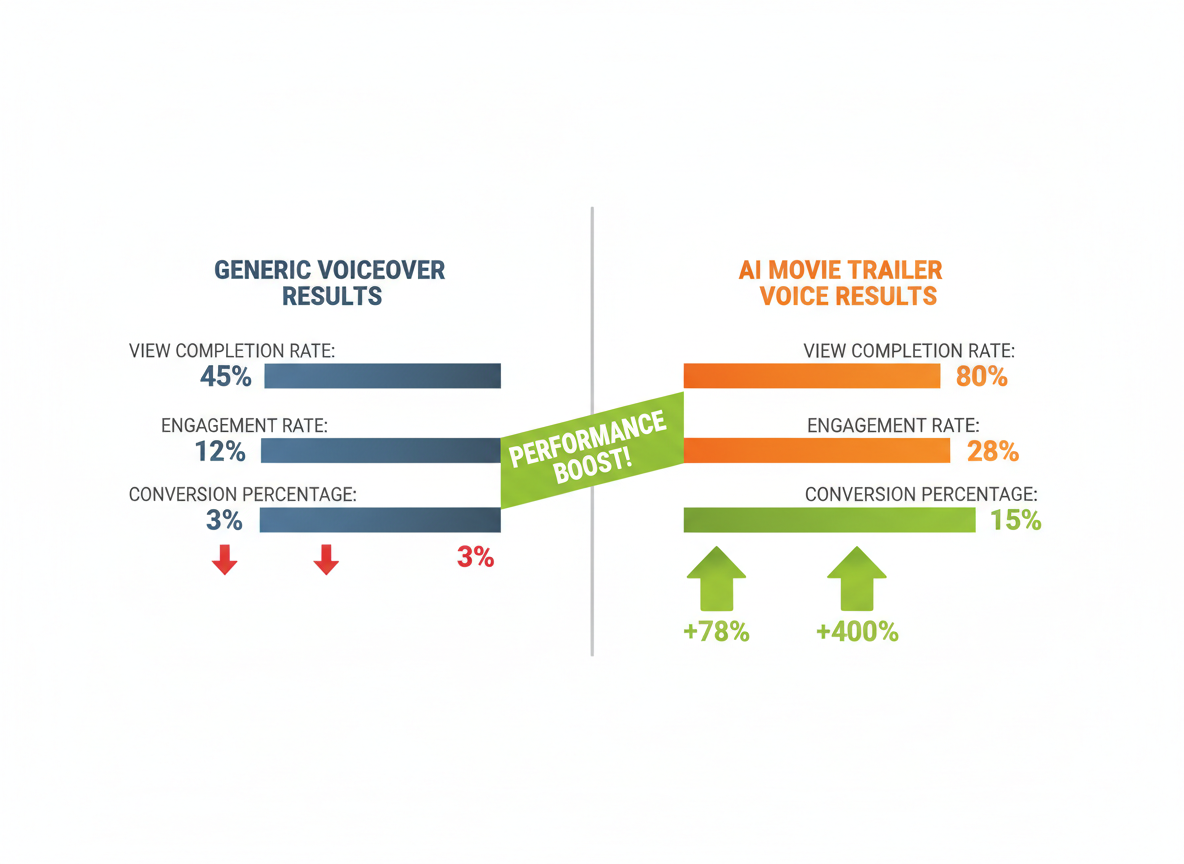
The numbers don't lie. When agencies switch from generic voiceovers to professional ai movie trailer voice implementations, their clients see immediate, measurable improvements.
Take Marcus Digital, a boutique agency in Austin. They retrofitted three underperforming video ads for a fitness client using cinematic AI voiceovers. The original ads had a 23% completion rate and generated 4.2% conversions. After swapping in that deep, authoritative trailer voice? Completion rates jumped to 61%, and conversions nearly tripled to 11.8%. Same visuals. Same targeting. Different voice.
The client renewed their contract for six months and increased their monthly retainer by $3,200.
Or consider Sarah Chen, a freelance video editor who added AI trailer voiceovers to her service menu. Within 90 days, she'd landed four new corporate clients specifically asking for "that movie trailer sound" on their product launches. Her average project fee increased from $850 to $2,400, and she's booking three weeks out consistently.
But let's talk about the operational wins that make this transformative for your business model.
Traditional voice talent booking burns 3-7 days between auditions, revisions, and final delivery. You're coordinating schedules, managing client feedback loops, and hoping the talent nails the read on take three instead of take seventeen. With AI movie trailer voice technology, you're turning around polished voiceovers in under two hours. One agency reported cutting their production timeline from 12 days to 3 days, allowing them to take on 40% more projects per quarter.
Cost savings stack up fast. Studio time, talent fees, and revision charges typically run $800-$2,500 per project. AI implementations cost a fraction while delivering consistent quality that doesn't have "off days" or scheduling conflicts.
The retention metrics tell an even better story. Agencies offering AI voiceover services report 28% higher client retention compared to those stuck with traditional methods. Why? Faster turnarounds, more competitive pricing, and unlimited revision capability without added costs.
Your clients get blockbuster-quality voiceovers. You get higher margins, faster delivery, and happier clients who stick around. That's not a theoretical benefit. That's how you build a service business that scales without drowning in operational complexity.
Pro Tips: Voice Directing Secrets From the Industry
Most people using AI movie trailer voice technology make the same fatal mistake: they treat it like a text-to-speech robot instead of a sophisticated performance tool. That's leaving serious money on the table.
Here's what the pros know that amateurs don't.
Script Adaptation That Actually Works
Your original script probably won't sound cinematic straight out of the box. You need to adapt for vocal delivery. That means breaking up dense paragraphs, adding strategic pauses with ellipses or em dashes, and replacing complex words with ones that punch harder. "Catastrophic" becomes "devastating." "Subsequently" becomes "then." The goal isn't dumbing down—it's sharpening impact.
Markup Techniques That Get Results
Professional voice directors annotate scripts with precision. Use brackets for pacing instructions [SLOW BUILD], all caps for EMPHASIS, and slashes for breath marks / that create tension. Mark emotional shifts with clear indicators like [MENACING] or [TRIUMPHANT]. The more specific your markup, the better your AI movie trailer voice will perform. Think of it as sheet music for drama.
Drama-Killing Mistakes You Can't Afford
The biggest killer? Over-explaining. Trailers aren't documentaries. Cut every word that doesn't serve the emotional arc. Second mistake: monotone pacing. If every sentence has the same rhythm, you've lost them. Third: ignoring the rule of threes. Great trailer copy clusters ideas in patterns of three because it just sounds more complete, more powerful, more memorable.
Audio Mixing That Elevates Everything
Raw AI output needs finishing. Layer subtle reverb to add space and presence—but don't drown the voice. Compress the dynamic range so whispers stay audible and shouts don't distort. Add a high-pass filter around 80Hz to remove mud. Then, and this matters more than you'd think, duck your music bed by 6-8dB when the voice enters. Your VO should sit slightly above the music, not fighting for attention.
Managing Client Expectations Like a Pro
Show clients three variations in your first round. One safe, one bold, one experimental. This frames the conversation and prevents endless revision cycles. Set clear revision limits upfront—typically two rounds included, then charge for additional changes. And always educate them on why certain choices work better than others. Clients who understand the craft become repeat buyers.
The Rapid Iteration Method
Generate five versions with subtle variations in pacing, intensity, and emphasis. Listen back-to-back without interruption. The winner usually reveals itself immediately. Trust your gut, tweak once, then move on. Perfection is the enemy of profit when you're building a service business.
Why This is a First-Mover Opportunity for Your Agency
Right now, there's a massive gap between what clients want and what most agencies can deliver.
Every business owner has seen those movie trailers with voices that make you sit up and pay attention. They want that same cinematic authority for their commercials, explainer videos, and brand content. But when they ask their agency about it? They're told to hire a $5,000-per-project voice actor or settle for generic text-to-speech that sounds like a GPS system.
You can be the agency that bridges this gap.
The market demand is exploding. Companies launching new products need launch videos that don't sound like a middle school presentation. Law firms want commercials that command respect. Medical practices need patient education videos that sound professional, not robotic. They're all searching for that ai movie trailer voice quality without the Hollywood budget or six-week turnaround times.
Here's what makes this opportunity so compelling: almost zero competition. While other agencies are stuck offering the same content writing and social media management services everyone else does, you'll be the only one in your market delivering cinematic-quality voiceovers at margins that'll make your accountant smile.
This isn't a low-margin commodity service. You're not competing on price with overseas freelancers. When you deliver movie trailer-level voice work that transforms a client's video from forgettable to phenomenal, you can charge premium rates. Better yet, the overhead is practically nothing compared to traditional video production services.
And you're already sitting on a goldmine of upsell opportunities. Every existing client who's ever mentioned video content, podcast production, or advertising? They're prospects for this service. You're not cold-calling strangers—you're offering a natural upgrade to people who already trust you and pay you.
Platforms like PodGorilla hand you everything you need: commercial rights, professional-grade voice generation, and complete systems that let you deliver like a seasoned Hollywood studio. You get the infrastructure without building it yourself.
But here's the reality: this window won't stay open forever. Six months from now, every agency in your space will have figured this out. The ones who move first will own the positioning as the voice authority in their market.
Frequently Asked Questions
Can AI movie trailer voices really match professional human voice actors?
Here's the truth: today's AI movie trailer voice technology produces results that 90% of clients can't distinguish from human talent. The voices carry emotional weight, dramatic pauses, and that signature gravitas you need. Will they replace top-tier $5,000-per-session Hollywood voice artists? Not yet. But for most commercial applications, indie films, and digital marketing campaigns, they're indistinguishable. The real question isn't whether they match human quality anymore—it's whether you're willing to leave money on the table while your competitors offer this service.
What's the cost difference between AI voices and hiring traditional talent?
Professional voice actors charge $200-$1,500 per trailer, with rush fees adding another 50-100% on top. Union rates go even higher. AI movie trailer voice technology costs you $30-$200 monthly with unlimited generations. Do the math. One client project pays for your annual subscription. Every project after that is pure margin. This isn't about replacing quality—it's about economics that make sense.
Do I need technical skills or audio engineering experience to create trailer voices?
None. Modern platforms handle the heavy lifting. You type your script, adjust intensity and pacing with sliders, and generate. Adding music and sound effects takes minutes with basic editing software. If you can write an email, you can create cinematic voiceovers. The technical barrier that protected traditional audio studios for decades? Gone.
Are there legal issues with using AI-generated voices commercially?
Depends entirely on your platform's licensing. Premium services include full commercial rights with your subscription. You own the output and can sell it to clients without restrictions. Read the fine print carefully—some free or cheap tools limit commercial use. When you're charging clients $500-$2,000 per trailer, spending an extra $50 monthly for bulletproof licensing isn't optional.
How long does it take to generate a professional movie trailer voiceover?
Ten minutes. Maybe fifteen if you're fine-tuning delivery. Traditional workflow with human talent? Schedule calls, wait 3-7 days for recording, request revisions, wait another 2-3 days. Rush jobs double your costs. AI lets you iterate in real-time, deliver same-day, and still charge premium rates because clients care about results, not your process.
Can I clone a specific voice or create custom voice profiles?
Advanced platforms offer custom voice training, though it requires audio samples and additional fees. Most agencies and freelancers succeed perfectly well with the 50-200 preset voices these platforms provide. Unless you're servicing major brands with specific voice guidelines, you won't need custom cloning. The presets cover everything from deep cinematic bass to edgy action voices.
What genres work best with AI movie trailer voices?
All of them. Horror, action, documentary, romance, sci-fi—AI voices handle the full spectrum. Different styles require different vocal approaches, and modern platforms offer specialized voices for each genre. Your limitation isn't the technology. It's your understanding of what each genre demands emotionally.
Do clients accept AI voices or do they demand human talent?
Clients demand results that convert. If your trailer generates views, drives ticket sales, or boosts engagement, they don't care how you created it. Most won't even ask. The ones who do care about "authentic" human voices typically can't afford top-tier talent anyway. Position yourself as the solution that delivers professional quality at accessible prices.
What platforms provide commercial rights for AI movie trailer voices?
PodGorilla offers comprehensive commercial licensing at https://www.podgorilla.co/exclusive, designed specifically for agencies and freelancers selling to clients. Look for platforms explicitly stating "full commercial rights" and "client work permitted" in their terms. Don't gamble with unclear licensing when you're building a business.
How do I price movie trailer voiceover services for clients?
Charge $500-$2,000 per trailer depending on length and project scope. Base pricing on market rates, not your costs. Traditional voice actors charge these rates, so clients expect them. Your margin is your competitive advantage—bank it, don't discount it. Package deals for multiple trailers or ongoing content relationships justify premium positioning.